AI for banks: where to start
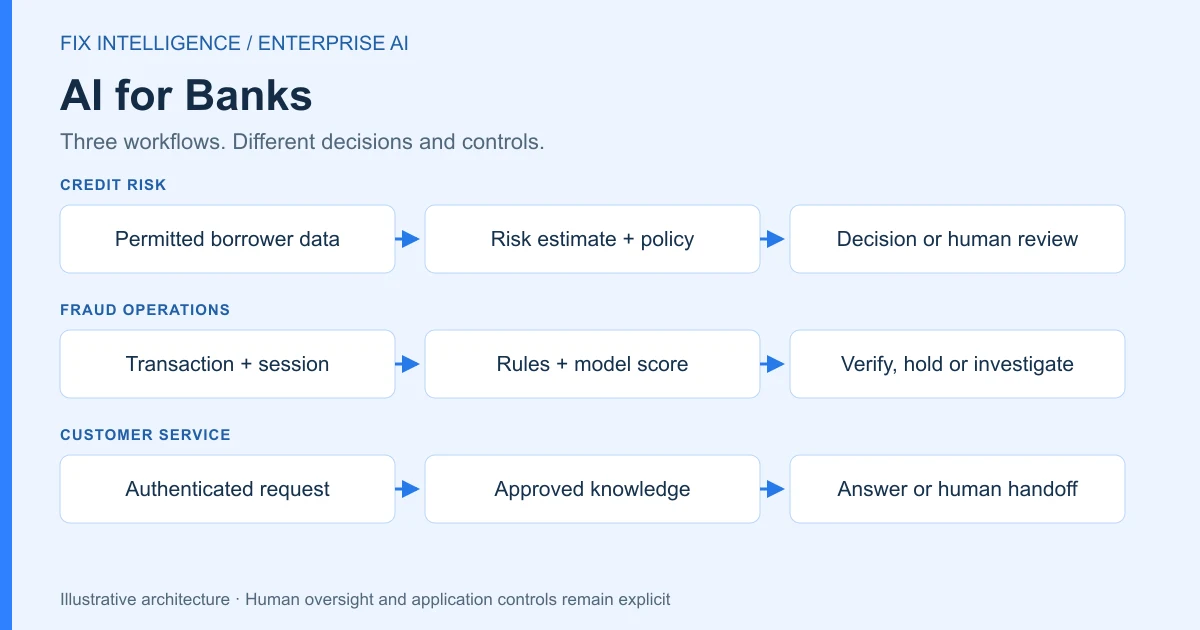
AI for banks works best when it improves a specific decision inside a controlled process. A lending model estimates risk; a fraud model prioritizes suspicious activity; a service assistant retrieves information and helps a customer complete an authorized task. Each needs different data, acceptance criteria, and oversight.
The investment decision starts with that distinction. A bank can have a useful customer-service assistant without being ready for automated underwriting. It can improve fraud investigation without allowing a model to block every transaction it considers unusual. The right starting point depends on the process, the available evidence, and the consequences of an error.
This guide connects the three use cases to architecture, implementation costs, and a practical rollout. It is intended for banking technology, operations, risk, and product leaders deciding what to build first.
Why banks are adopting AI now
Banks already operate with large volumes of structured transactions, application records, documents, and customer interactions. AI can help recognize patterns across those records and interpret unstructured inputs. Its value depends on whether that interpretation improves the next business action: a better review queue, a faster document check, or a clearer response to a customer.
There is also a practical change in how applications can be assembled. Predictive models, document extraction, retrieval, and language interfaces can be combined within existing software. That creates opportunities to modernize one workflow without replacing a core banking platform. It also creates dependencies that a pilot must expose, including source permissions, provider availability, and the quality of historical decisions used as training labels.
Financial-sector AI introduces risks alongside its potential benefits. The BIS discussion of financial stability implications identifies concerns involving model risk, governance, data quality, and explainability. An implementation should therefore have an operational owner and a risk owner from the start. BIS discussion of financial stability implications.
Choose a measurable baseline before selecting a model. For credit operations, that might be time spent reviewing incomplete applications. For fraud, it might be investigator workload at a defined detection threshold. For service, it might be correctly resolved requests that do not return as repeat contacts. A count of model calls is not a substitute for those outcomes.
Choose the first workflow by readiness and consequence
Assess a candidate along two axes: whether the bank can observe a reliable outcome, and how much authority the application needs. A document-preparation task with human approval may provide a clearer first evaluation than a decision whose consequences become visible only months later. The less consequential task is not automatically the more valuable one, but it may expose integration and operating requirements with a smaller initial release boundary.
Create a short decision record for each candidate. Name the current process owner, describe the customer or employee task, identify the permitted data, and state what evidence would support expansion. Include the cost of an error and the team's ability to detect and correct it. This prevents a technically impressive prototype from becoming the default priority without a business comparison.
For example, a service assistant using public product information may have accessible sources and a rapid review cycle. An underwriting model needs mature repayment outcomes and a carefully defined decision process. A fraud-scoring service may need fresh event features and a channel-specific response deadline. These differences should determine the pilot design rather than disappear into a shared label such as banking AI.
Ask suppliers to show the artifact that will make each milestone reviewable: a data-quality report, an integration contract, a representative test set, or a controlled-release record. A demonstration is useful for exploring an idea, but it should not replace those deliverables. Give technology, business, and risk reviewers a common acceptance record so disagreement is resolved before the application gains more authority.
Use case: credit scoring and risk assessment
AI credit scoring uses historical data to estimate a defined lending outcome, such as default within a specified period. The outcome definition matters as much as the model family. A model trained on one product, applicant population, or economic period cannot be assumed to work on another.
Separate the score from the lending policy. The score is one input; the policy determines how the bank combines it with affordability, product rules, required checks, and review. Keeping these layers distinct helps the bank explain a decision, change a policy without silently retraining a model, and investigate disagreements between an automated recommendation and an underwriter.
Build a decision record, not just a prediction
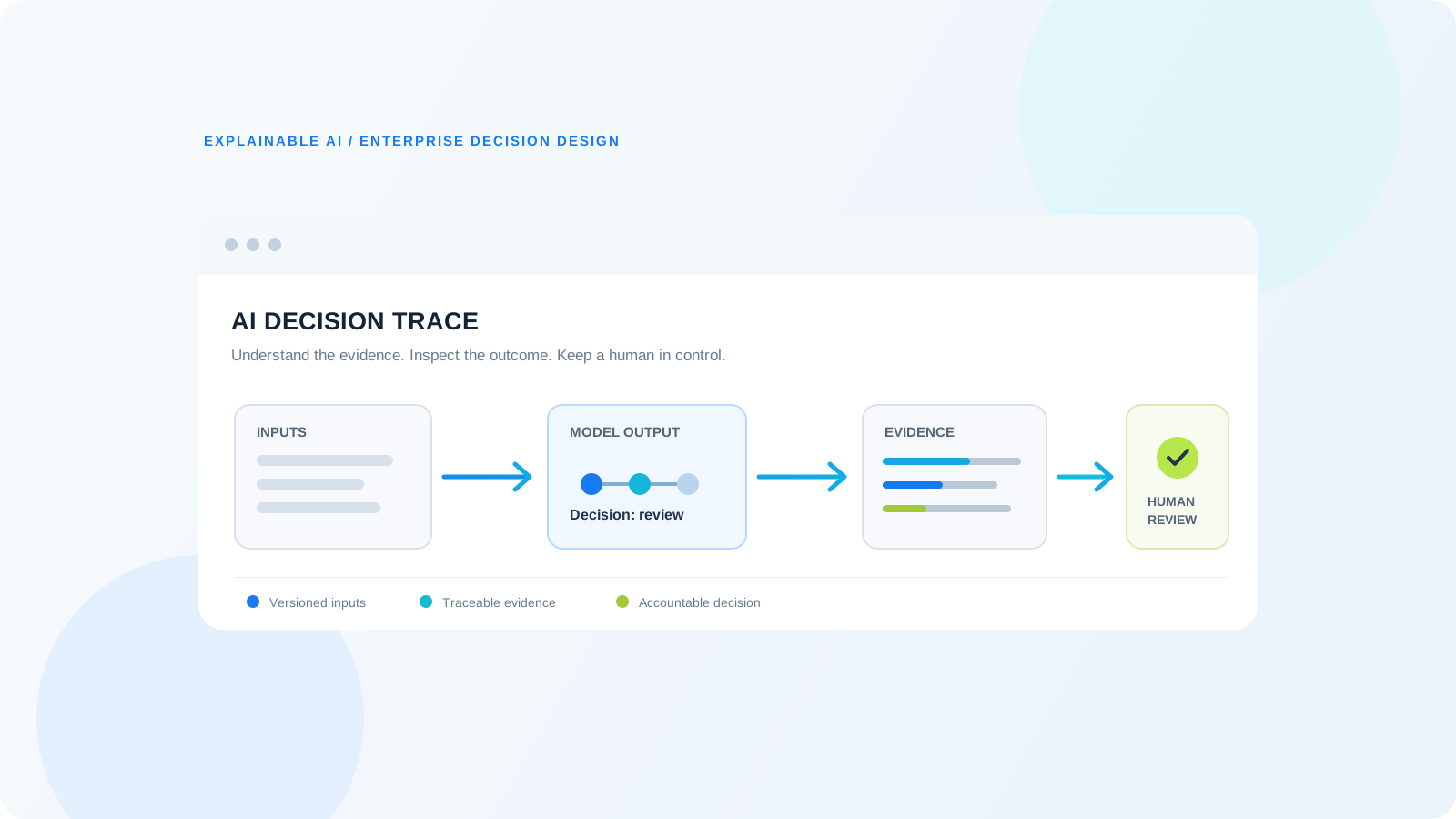
A useful record contains the information available at the decision time, the feature and model versions, the returned score, the policy version, the decision, and any override. A later investigation should be able to reconstruct why a specific application followed a particular path.
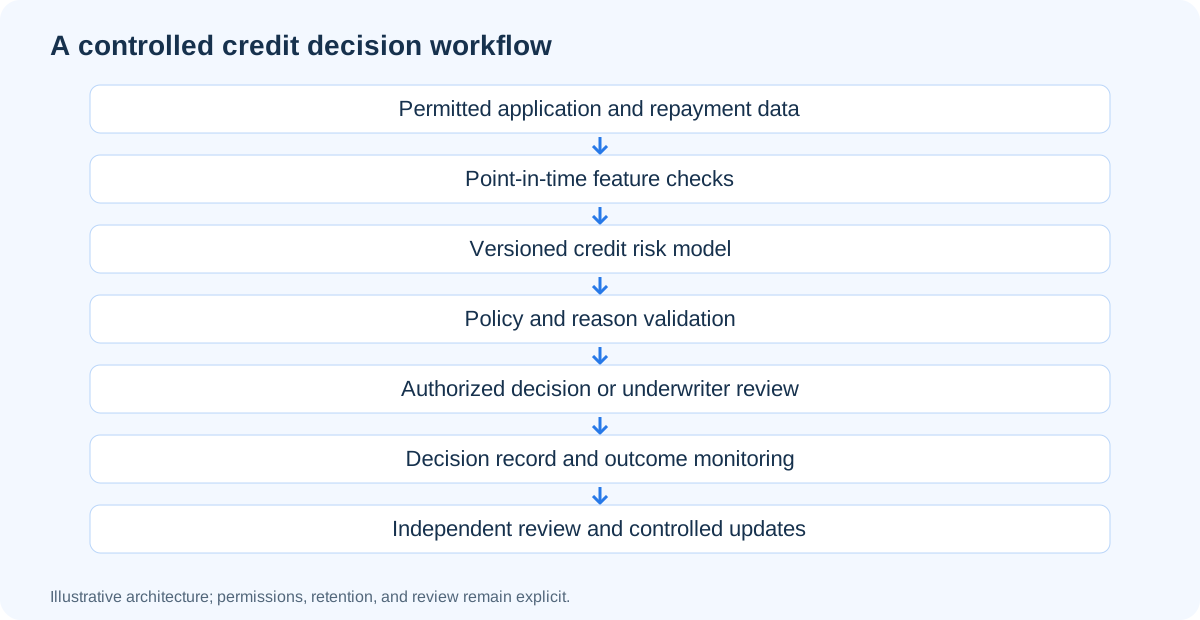
This is an example architecture, not a description of a deployed FIX customer system. A deployment must also define access control, retention, missing-data behavior, and the process for challenging or correcting inaccurate information.
Evaluate the lending outcome honestly
Compare the candidate against the bank's existing scorecard or review process. Use time-separated evaluation and examine calibration, expected loss, approval outcomes, and relevant population segments. Look for information that would only become available after the original application: including it in training or evaluation can create misleading performance.
Explainability belongs inside the decision design. For U.S. lending, Regulation B's notification provisions govern adverse-action notices in the circumstances they cover. The legal obligations for a particular bank and product need jurisdiction-specific review. A generic feature-importance chart is not automatically an adequate customer explanation. Regulation B's notification provisions.
Our separate guide to explainable credit scoring and fair-lending controls examines that issue in greater depth. This pillar focuses on deciding where credit scoring fits in the overall banking AI portfolio. explainable credit scoring and fair-lending controls.
Explore: How AI credit scoring works and compares with traditional scorecards
Use case: real-time fraud detection
Fraud detection combines evidence about an event with the bank's response policy. Relevant signals can include transaction history, beneficiary changes, device information, session behavior, and relationships between accounts. Their usefulness depends on availability, legitimacy, freshness, and whether the bank can act on them within the channel's deadline.
The scoring service should not be the only control. A transaction may pass through deterministic checks, a predictive model, a policy engine, and an investigator queue. The response could be approval, step-up verification, a temporary hold, or review. Those actions have different consequences for customers and different operational costs.
Treat false positives as a design constraint
An alert is only useful if the bank can investigate or resolve it. A threshold that catches additional suspicious events may also create more interruptions for legitimate customers. Measure confirmed fraud found, losses where attribution is supportable, review volume, customer friction, and investigator capacity together.
Use historical replay before controlling live decisions. Then run a shadow deployment that records proposed actions without changing the transaction outcome. Compare those recommendations with the current stack and follow up when labels arrive. Keep the same outcome window when comparing systems; chargebacks and investigation results are often delayed.
Deepfake and voice-cloning scams require an additional identity and authorization perspective. Detecting unusual transaction patterns does not prove that a caller is genuine. Use independent verification for sensitive changes and avoid treating a familiar voice as permission to move money. The enterprise deepfake-fraud controls guide explores these attack paths without assuming a detector can eliminate them. enterprise deepfake-fraud controls guide.
Use case: AI customer service and virtual agents
A banking assistant can begin with public product information and approved support content. Authenticated account enquiries need a different boundary: the application must establish identity, authorize access, and retrieve only permitted information before the model responds.
The assistant's conversation and its tool permissions should be designed separately. A request to explain a fee may need retrieval. A request to change a beneficiary requires a defined transaction workflow, stronger verification, and appropriate approval. Model-generated instructions must never become the authority for a sensitive action.
Design the handoff as part of the product
The human service team should receive the customer's issue, relevant source material, actions already confirmed, and any unresolved uncertainty. It should not receive a long conversation with no indication of what is reliable. Customers also need a clear way to reach a person when the assistant cannot help.
Measure whether the request was correctly resolved, not simply whether the conversation ended without an agent. Repeat contacts, incorrect policy answers, unsuccessful handoffs, and unnecessary authentication loops can erase an apparent productivity gain.
For internal employee assistants, the same principles apply to access and provenance. Permissions should follow the employee and the source, including when knowledge is indexed. The RAG and knowledge systems service describes the ingestion, retrieval, and evaluation work behind that capability. RAG and knowledge systems service.
What it costs to implement
There is no reliable universal price for banking AI. Two projects with the same visible interface can have very different costs because one uses approved public content and the other writes to a regulated transaction system. Scope the workflow, integrations, controls, and validation obligations before comparing proposals.
| Cost area | What the estimate should include | Common source of underestimation |
|---|---|---|
| Discovery and risk assessment | Process mapping, data access, intended use, legal-role review | Unresolved ownership and approval requirements |
| Data preparation | Quality checks, labels, permissions, historical snapshots | Inconsistent identifiers and delayed outcomes |
| Application and integration | Interfaces, identity, APIs, review queues, recovery | Legacy-system constraints and write controls |
| Evaluation and validation | Baselines, scenario tests, independent review | Work required to demonstrate acceptable behavior |
| Production operation | Inference, infrastructure, monitoring, support | Retries, peak traffic, incident response, and model changes |
An illustrative budgeting model
For planning only, assume a bounded application requires four delivery contributors for twelve weeks at an assumed blended allocation of USD 2,000 per contributor-week. That produces USD 96,000 of delivery effort. Add an assumed USD 6,000 for environments and tooling and USD 12,000 for specialist validation: the illustrative total is USD 114,000.
These are invented planning inputs used to show the calculation, not a FIX quotation, supplier benchmark, or promise that this scope is sufficient for a bank. A more complex integration, additional approval work, or delayed data access could change both the staffing and the elapsed time. Replace every assumption with a scoped estimate before using the model for procurement.
Model operating costs separately. Include accepted transactions or completed service requests as the unit of work, with retried model calls, retrieval, review, and support inside the cost boundary. A smaller model can be cheaper per call and more expensive per accepted result if it creates additional errors or escalation. See the banking model-routing cost scenario for a clearly labelled example of that trade-off. banking model-routing cost scenario.
Measure return against a stable baseline
Define the benefit before rollout and avoid counting the same improvement twice. Time saved in document preparation may create capacity without reducing headcount expenditure. Fraud losses prevented require an attribution method, rather than a count of flagged transactions. Improved service resolution may matter even when the number of contacts does not fall.
Report the observation period, sample coverage, quality threshold, operating cost, and remaining uncertainty beside any ROI figure. A pilot result from a narrow queue should remain a queue-level result until evidence supports wider extrapolation.
How to roll it out with the right controls
Start with a workflow that has a clear owner, accessible data, and an observable outcome. Document which decisions remain with employees and which actions the software may execute. Include a fallback for unavailable dependencies and a process for handling disputed outputs.
Establish the baseline and inventory
Record the intended purpose, affected users, data categories, model dependencies, interfaces, and deployment boundary. Identify whether the system produces advice, predictions, drafts, or binding actions. That distinction helps risk and legal teams determine what evidence they need.
For U.S. organizations within its scope, the Federal Reserve's SR 26-2 revised model-risk guidance replaced SR 11-7 in April 2026. Treat applicability as a specific assessment, rather than assuming one document governs every bank internationally. SR 26-2 revised model-risk guidance.
Validate before expanding authority
Test missing data, unusual customers, malicious inputs, permission changes, provider failures, and ambiguous outcomes. Separate testing of model quality from testing of the application controls around it. A reliable classifier does not prove that a tool call respects account permissions.
Use shadow operation and a controlled release to compare behavior with the baseline. Agree on stop conditions before the rollout: unacceptable leakage, a critical permission failure, an unsustainable review backlog, or deterioration in a required quality measure. The rollback path should be rehearsed, not discovered during an incident.
Assign ownership after launch
Someone must own model changes, source-data changes, prompt changes, operating incidents, and customer complaints. Establish review intervals that reflect risk and material system changes. Keep evaluation records linked to the released artifact so the bank can identify what changed when performance shifts.
The voluntary NIST AI Risk Management Framework provides a useful organizing reference for AI risk activities. It is not a substitute for the bank's applicable legal and supervisory obligations. NIST AI Risk Management Framework.
Book an AI for Banking consultation
FIX Intelligence, the AI brand of FIX Solutions JSC, can help scope the workflow, integrations, evaluation, and operating controls for a banking AI project. Bring one process, its current baseline, and the constraints your technology and risk teams need to preserve.
Book an AI for Banking consultation or explore AI for Finance services. Book an AI for Banking consultation. AI for Finance services.
AI readiness checklist for your first discussion
- Name the decision or task and its accountable owner.
- Identify the permitted data and the baseline outcome.
- List the systems the application will read and write.
- Define human review, exceptions, and stop conditions.
- Agree on evaluation evidence and an operating-cost boundary.
- Assign ownership for incidents, changes, and customer questions.