AI credit scoring: the starting point
AI credit scoring estimates a defined lending outcome from borrower and account information. Its value comes from finding useful relationships in that data and applying them consistently. The score still needs a decision policy, validation, and a way to explain how the bank used it.
For a bank evaluating a new model, the important comparison is with its current lending process. A higher ranking metric in a development notebook does not establish better lending outcomes. The bank needs evidence that the model works for its products, customers, and decision constraints.
What AI credit scoring is
A credit-risk model starts with a target: for example, default within a specified period after a loan is originated. Historical records provide observations of the information available when applications were assessed and the outcomes observed later. The training process estimates relationships between those inputs and the target.
The model might return a probability estimate, a ranking score, or another risk measure. These outputs are not interchangeable. A ranking can help order applications by estimated risk without supplying a well-calibrated probability. If a bank needs probability estimates for a downstream calculation, it must evaluate that property separately.
The decision system then combines the output with the bank's policy. Product eligibility, affordability, missing documentation, and required review can affect the final action. Keeping the prediction and policy distinct helps the bank investigate whether an unexpected decision came from the model or from a business rule.
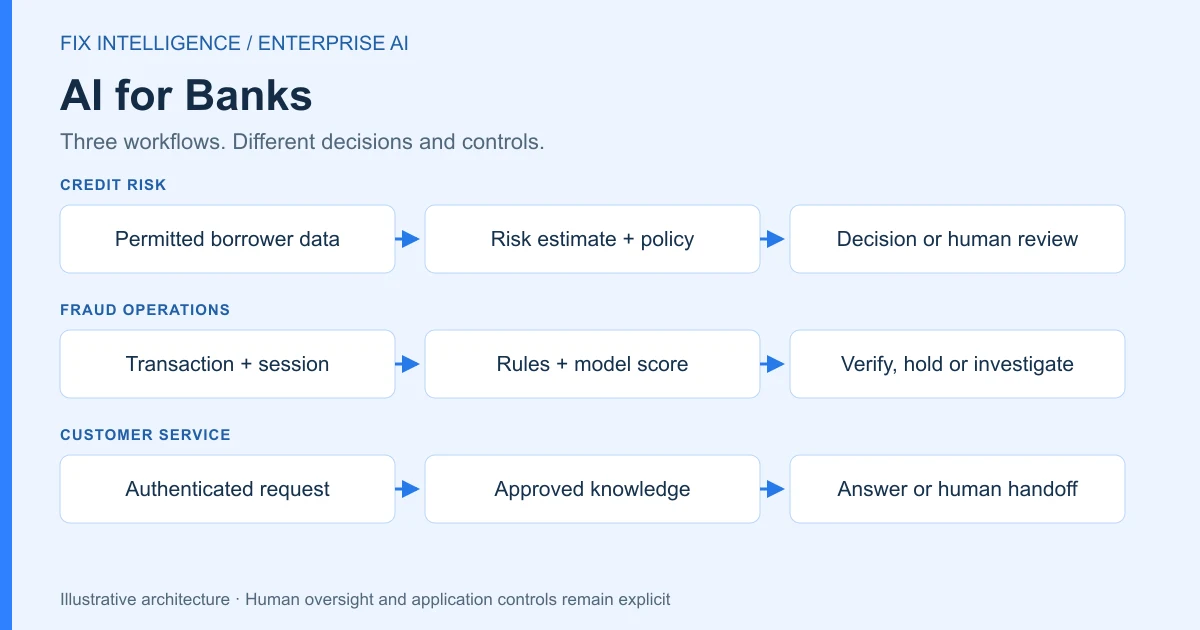
The broader AI for banks guide places credit scoring alongside fraud detection and customer-service use cases. Their shared infrastructure does not make their evaluation criteria identical. AI for banks guide.
How it differs from traditional scorecards
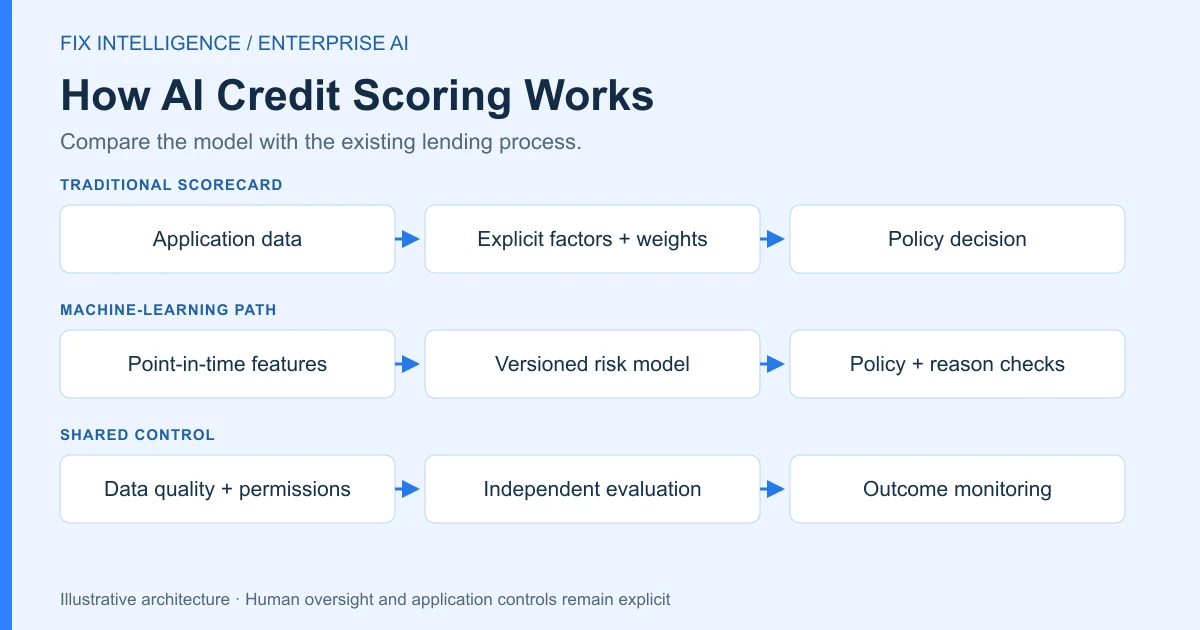
Traditional scorecards often use explicit bins, weights, or statistical relationships that are relatively straightforward to inspect. Machine-learning approaches can model more complex interactions. That additional flexibility also creates more work to control leakage, instability, and explanations.
| Question | Traditional scorecard approach | Machine-learning approach |
|---|---|---|
| How are relationships represented? | Often explicit factors or simpler statistical functions | May include nonlinear interactions across many features |
| What is the main trade-off? | Simpler inspection can constrain the patterns captured | Flexibility increases validation and explanation demands |
| What should be compared? | Current lending outcomes and review process | The same outcomes on comparable, time-separated data |
| What must remain controlled? | Data quality, policy, overrides, and updates | Those same controls, plus model-specific failure modes |
A bank does not need to abandon a scorecard simply because a more complex model is available. The candidate must justify its additional implementation and governance costs. A simpler model that meets the required operating criteria can be the stronger choice.
Data sources: traditional and alternative data
Potential inputs include application information, repayment records, account behavior, and permitted credit-report data. The key questions are whether the data is accurate, lawfully available, relevant to the product, and available at the actual decision time.
Alternative data requires particular care. A new signal may encode a protected characteristic indirectly, vary with access to technology, or be difficult for an applicant to correct. More data is not automatically better data. Establish the purpose and control requirements for each feature before adding it to a training set.
Create point-in-time snapshots. A payment outcome recorded after origination must not appear among the features used to predict the original application. Likewise, a later manual investigation may introduce information that the live system could not have known. Such leakage can make a development result look much stronger than production behavior.
Review whose outcomes are observable. If the historical dataset only includes approved applicants, outcomes for declined applicants are missing. That selection affects what can be concluded about a new approval policy. State the limitation rather than assuming the observed sample represents every applicant.
Model types and explainability
Candidate approaches can include logistic regression, tree-based models, and other supervised methods suited to the data and outcome. Evaluate them against the same baseline and splitting strategy. Keep preprocessing, feature definitions, missing-value handling, and configuration under version control.
Compare discrimination and calibration separately. Discrimination concerns how well the model distinguishes outcomes; calibration concerns whether estimated probabilities correspond to observed frequencies. The scikit-learn calibration documentation explains this distinction and methods for assessing probability estimates. scikit-learn calibration documentation.
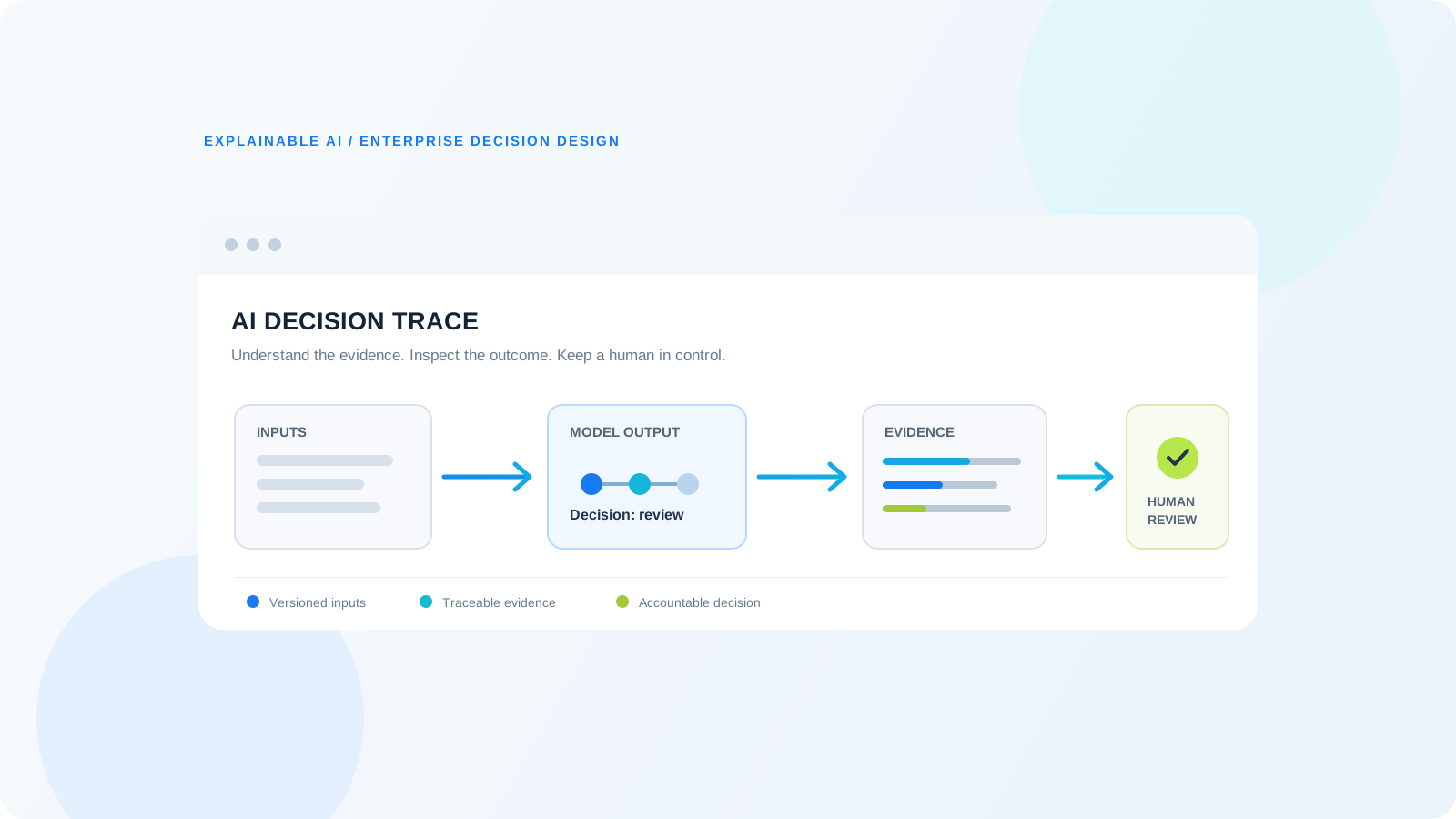
An operational explanation also needs a defined purpose. A model-development visualization, an underwriter's reason summary, and a customer notification are different outputs. Their accuracy should be tested against the actual decision pipeline, including rules and overrides.
For U.S. credit decisions within its scope, Regulation B sets requirements for relevant notifications and reasons. Applicability and notice design require legal review. For a deeper treatment of explanations, use the existing fair-lending and explainable AI guide. Regulation B. fair-lending and explainable AI guide.
Risks: bias, drift, and regulatory review
Evaluate performance across relevant customer and product segments. A favorable aggregate result can conceal poor calibration or disproportionate errors in a smaller population. Review feature proxies, missing-data patterns, and manual overrides with the bank's risk and legal specialists.
Monitor changes in both inputs and outcomes after launch. A shift in application mix does not by itself prove that predictive quality has deteriorated, while an apparently stable input distribution does not guarantee stable repayment behavior. Outcome monitoring must account for the time required for labels to mature.
Record the model version, policy version, source snapshot, explanation, and final decision for each application as appropriate to the bank's controls. Independent review should be able to challenge the assumptions and reproduce the relevant behavior. In the U.S., SR 26-2 is the revised 2026 model-risk guidance; institutions should assess its scope rather than relying on superseded references. SR 26-2.
A staged rollout can compare the candidate with the current process before expanding its authority. Define who can approve changes, how a model is disabled, and what applicants experience when the service is unavailable. Coordinate related controls with banking fraud detection while keeping the credit and fraud objectives separate.
Plan the credit workflow before the model
FIX Intelligence can help connect data preparation, model integration, review interfaces, and evaluation around a defined lending workflow. Begin with the outcome, the baseline, and the decisions that need human authority.
Discuss an AI for Banking project or return to the AI for banks implementation guide. Discuss an AI for Banking project. AI for banks implementation guide.