Why model routing matters in banking
A single frontier model can be convenient, but sending every customer question, document label, and complex analysis request to the same endpoint may be expensive and difficult to govern. Many banking workflows contain a large share of bounded tasks—classification, routing, retrieval from approved help content, and structured extraction—that may not require the most capable model available.
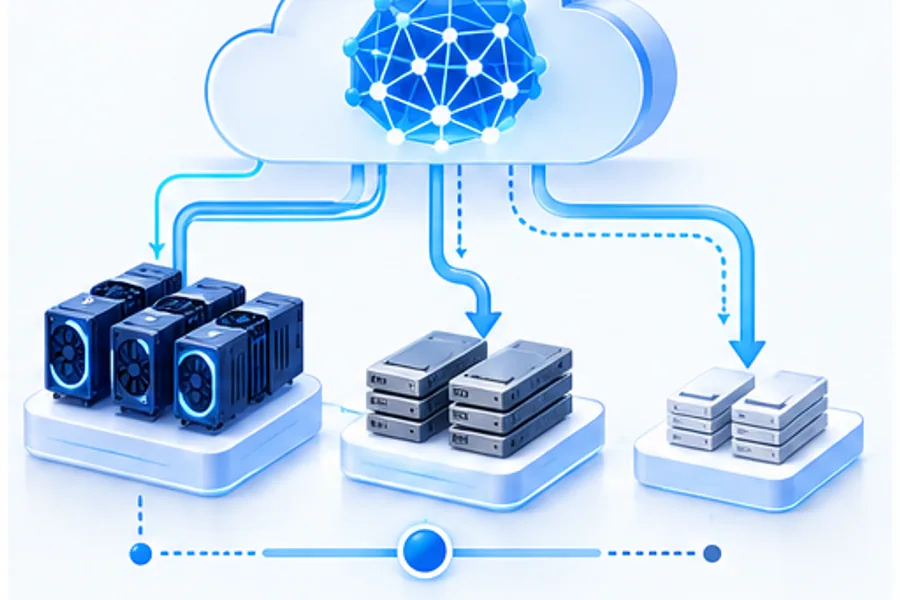
A hybrid cascade routes work according to task type, sensitivity, expected difficulty, and quality requirements. Deterministic rules handle predictable checks; a small language model (SLM) may handle a narrow, repeatable task; and a larger model or trained employee handles ambiguity and complex reasoning. This is a workload design choice, not a general claim that smaller models are always cheaper or safe enough.
An illustrative 80% inference-cost scenario
Consider an explicitly hypothetical workload where 85% of requests are eligible for a self-hosted SLM and the remaining 15% use a frontier model. Assume, solely for illustration, that the fully allocated SLM inference cost per comparable request is 5% of the frontier-model cost. Normalizing the frontier request cost to 1 gives blended model cost of (0.85 × 0.05) + (0.15 × 1) = 0.1925. That is approximately 80.8% lower inference cost than sending every request to the frontier model.
This calculation is not evidence that Tier-1 banks routinely achieve an 80% reduction. It is also not a total-program cost estimate. Hardware amortization, utilization, engineering, orchestration, evaluation, redundancy, security, on-call support, model refreshes, and human review may materially change the result. If an SLM fails often and triggers retries or escalations, its apparent unit-cost advantage can disappear.
Explore: enterprise small language model deployment and evaluation
Route by confidence, policy, and business impact
Start with a request classifier and explicit policy gates. Route routine, non-transactional questions or bounded document classes to a candidate SLM only when the task and data are within its tested envelope. Use deterministic validation against approved sources for facts such as account status, rates, balances, or eligibility; a language model should not invent or independently determine those values.
Escalate to a more capable model or a human when required fields are missing, retrieval is weak, confidence is below a validated threshold, the request is novel, or the action could affect money, access, legal rights, or customer commitments. Keep authentication, authorization, transaction limits, and approvals outside the model. The router should fail safely when model health, policy services, or source systems are unavailable.
Evaluate the cascade as one production system
Build a representative evaluation set by task, language, product, risk tier, and edge case. Compare the SLM, frontier model, and full cascade on task accuracy, groundedness, refusal behavior, sensitive-data leakage, latency, escalation rate, and cost per accepted outcome. Test routing errors separately: a router that sends a hard request to the cheap model can be more harmful than a weak answer from either model in isolation.
Run in shadow mode before changing live traffic, then introduce the cascade gradually with quality gates and rollback. Sample outputs with controlled access, track drift and false acceptance, and review cost alongside customer and operational outcomes. Retain the route and model versions needed for audit, but minimize sensitive prompt content in logs.
Decide what belongs on-premises or in a private environment
Self-hosting an SLM may support data-control, latency, or predictable-capacity objectives, but the bank assumes responsibility for hardware utilization, patching, access, availability, model updates, and incident response. A managed private endpoint can shift some operations to a provider but requires scrutiny of contractual retention, support access, subprocessors, and regional processing. Compare the full cost and risk boundary rather than equating “self-hosted” with “free” or “compliant.”
Set a model owner, budget, approved use cases, service target, and retirement criteria for each tier. Reassess the cost ratio as provider prices, model quality, volume, and compute utilization change. The best cascade is the simplest routing policy that meets the bank’s quality and control requirements at a defensible total cost.