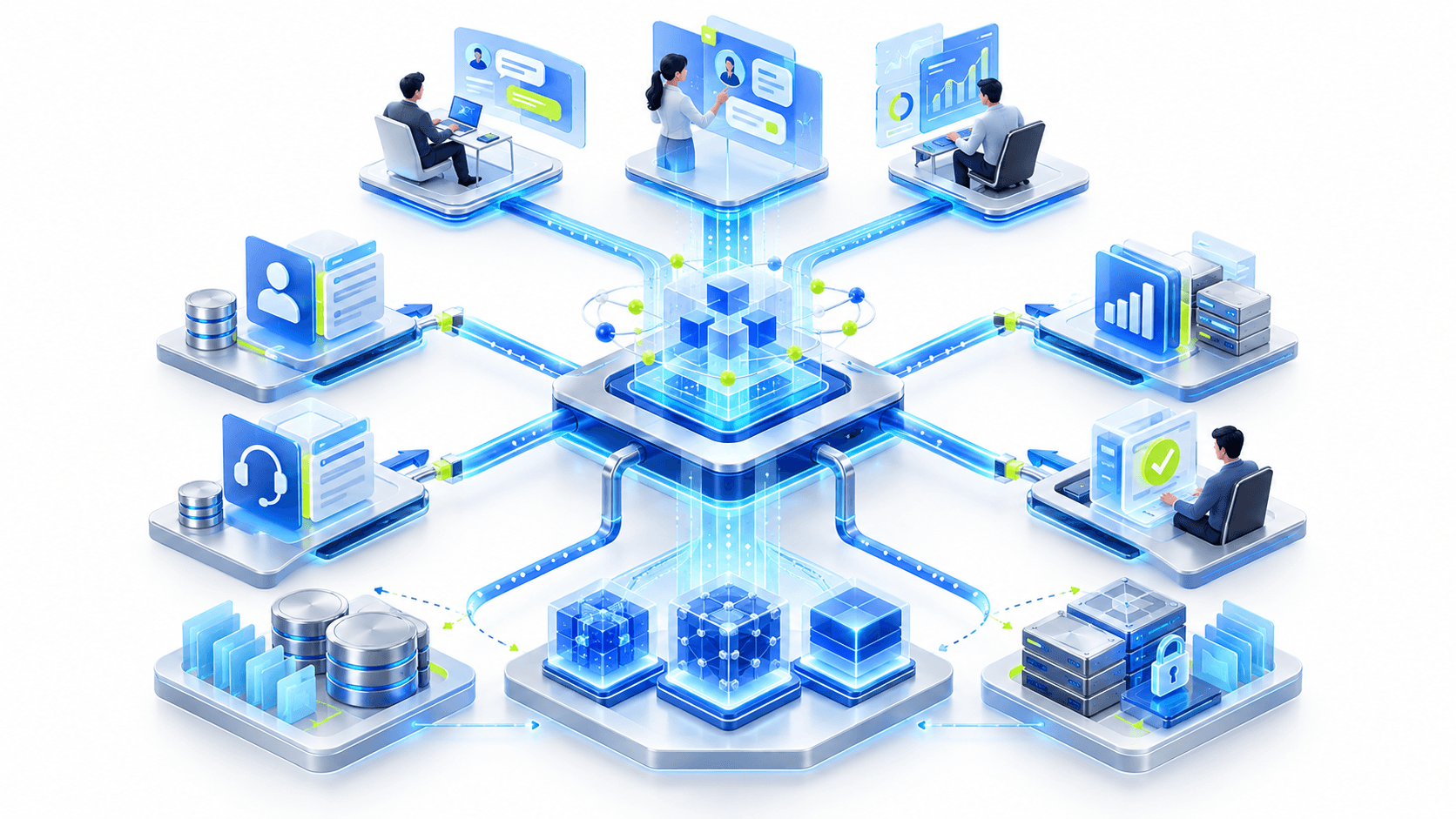
The 2027 shift: from AI features to operating models
For enterprise technology leaders, 2027 is likely to be less about adding another AI feature and more about redesigning how software is built, how work is coordinated, and how organizations establish trust in automated decisions. The important unit of change is no longer only the model. It is the operating system around the model: the data it can access, the tools it can use, the people accountable for outcomes, and the evidence that shows whether the system works.
Several signals point in this direction. AI-native development platforms, multiagent systems, Physical AI, and Digital Provenance have already entered major strategic technology discussions. Their significance is not that every enterprise should deploy each capability immediately. Rather, the signals expose architectural questions leaders need to answer: how software is assembled, how agents receive authority, how AI-generated artifacts are verified, and how digital decisions safely influence physical operations.
This article treats the six topics below as a planning outlook, not a promise that every prediction will arrive on schedule. Adoption will vary by industry, regulation, data maturity, and economics. The executive task is to separate near-term capability from long-term ambition, then prepare platforms and governance so useful systems can scale without turning experimentation into uncontrolled complexity.
1. Intent-Driven Software: express the outcome, govern the execution
Intent-Driven Software describes a shift from users navigating a fixed sequence of screens toward expressing an outcome and allowing software to assemble an appropriate path through approved data and capabilities. A finance manager might ask to reconcile a supplier discrepancy; a service leader might request a review of recurring customer complaints; an engineer might describe a change and ask the development environment to propose an implementation. In each case, the system interprets intent, gathers context, and prepares a workflow rather than merely returning text.
For CIOs, this could make enterprise software feel less like a collection of disconnected applications. But natural-language intent is not a substitute for precise authorization. The system must resolve identity, understand which records the user may access, disclose assumptions, and distinguish reversible preparation from consequential execution. If an instruction is ambiguous, the correct behavior may be to ask a question or present options, not infer the most aggressive interpretation.
The architecture therefore needs a translation layer between intent and action: structured plans, policy checks, tool permissions, validation, approval points, and an auditable record. Teams should test paraphrases, missing information, conflicting instructions, and prompt-injection attempts. Measure whether users reach the desired outcome with less effort and fewer errors, not simply whether the interface accepts conversational input. Intent-Driven Software will be valuable where flexible interaction is paired with deterministic boundaries.
2. Digital Provenance: make origin and change history inspectable
As AI creates and transforms documents, code, images, audio, datasets, and decisions, organizations need better answers to basic questions: where did this artifact come from, what changed, which tools or models touched it, and who approved its use? Digital Provenance is the practice of recording and validating relevant origin and history information. It can apply to customer-facing media, regulated records, software dependencies, training data, and internal knowledge—not only deepfake detection.
A provenance record may combine signed metadata, content credentials, version history, source references, workflow events, and human attestations. The right implementation depends on the artifact and threat model. A signed record can help detect tampering or establish that a system made a claim about origin; it does not prove that the underlying content is true, complete, lawful, or safe. Metadata can be stripped, keys can be compromised, and the first captured source may itself be misleading. Provenance is evidence to interpret, not a truth oracle.
CTOs should identify the business decisions that depend on origin: publishing a campaign, accepting a supplier document, merging generated code, or relying on an AI-produced analysis. Define the minimum evidence required at each handoff and retain it with the artifact. Connect provenance to identity, access management, data classification, and incident response. Start with high-value content flows where traceability reduces fraud, rework, or compliance uncertainty, then standardize the record format and retention model across teams.
3. Multiagent Systems: specialization helps only with coordination
Multiagent Systems divide a complex task among multiple AI agents that may have different roles, tools, data scopes, or evaluation criteria. One agent might retrieve evidence, another compare it with policy, and a coordinator might assemble a recommendation for a human reviewer. This modularity can make a complex process easier to reason about than one monolithic prompt, particularly when the workflow crosses domains or requires independent checks.
However, adding agents also adds interfaces and failure modes. Agents can pass incorrect assumptions to one another, duplicate work, disagree without resolution, or create long chains that are hard to observe. More agents do not guarantee better reasoning; the coordination overhead can exceed the benefit. A dependable design states each agent’s role, allowed tools, input and output contract, stopping condition, and escalation behavior. It also records the trajectory so operators can determine which step produced a bad result.
The first enterprise use cases should be bounded and testable: research and evidence assembly, exception triage, software change preparation, or case routing. Use a deterministic orchestrator where the sequence is known and reserve agent discretion for steps that genuinely depend on context. Evaluate end-to-end task success, policy compliance, tool correctness, recovery, latency, and cost. Compare the multiagent design with a simpler single-agent or conventional workflow baseline before accepting its extra operational burden.
4. AI-Native Development Platforms: reshape the software delivery system
AI-Native Development Platforms bring AI into the software development lifecycle rather than treating coding assistance as an isolated editor feature. The platform may connect requirements, repository context, architecture guidance, code generation, test creation, security scanning, review, deployment, and operational feedback. Its promise is not simply faster typing. It is to reduce friction across the path from an idea to a maintainable, secure change running in production.
This changes the work of engineering leaders. Developers may spend less time on boilerplate and more time specifying constraints, evaluating proposed changes, integrating systems, and diagnosing behavior. Platform teams become responsible for trusted context, permission boundaries, reusable workflows, evaluation, and auditability. A model that can edit a repository should not automatically receive unrestricted access to production secrets or deployment authority. Sandboxed execution, branch-level change review, protected environments, and reproducible tests remain essential controls.
The key risk is optimizing visible code output while degrading the whole delivery system. More generated code can increase review load, architectural inconsistency, dependency exposure, and maintenance work. Measure lead time, change failure rate, defect escape, review effort, developer experience, and cost per accepted change. Compare cohorts and task types rather than declaring success from aggregate acceptance or lines of code. The platform should amplify sound engineering practices; it cannot compensate for unclear ownership, weak tests, or unstable architecture.
5. Physical AI: bring intelligence into operational environments
Physical AI connects perception, reasoning, and action in the real world through robots, autonomous equipment, vehicles, drones, or intelligent infrastructure. Unlike a digital assistant, a physical system interacts with people, machinery, materials, and environments that can change unexpectedly. A small software error may affect equipment, product quality, worker safety, or continuity of operations. The path from a successful demonstration to repeatable deployment is therefore an engineering and operational challenge, not only a model challenge.
A practical architecture links sensors and cameras to edge inference, planning, control systems, fleet management, and enterprise data. Simulation and digital twins can help teams test scenarios before deployment, but a simulation result is not proof of safe real-world behavior. Physical conditions differ: lighting, surfaces, loads, sensor calibration, network interruptions, and human behavior all matter. Pilots should establish a clear operating envelope, including the tasks the system may perform, environmental conditions, speed or force limits, and situations that require human intervention.
Begin with repeatable tasks in controlled environments where baseline performance and fallback behavior can be measured. Keep safety functions independent of generative or probabilistic decision paths, and define emergency stop, manual override, recovery, and maintenance procedures. Monitor near misses and degraded performance, not only completed tasks. CIOs should treat IT/OT integration, cybersecurity, workforce training, and service support as part of the investment case. Scale only when operational evidence demonstrates stable performance across shifts, sites, and realistic variation.
6. Intelligent Automation: combine deterministic control with adaptive AI
Intelligent Automation is evolving beyond isolated robotic process automation. Enterprise workflows increasingly combine event-driven software, business rules, machine learning, language models, process mining, and human decisions. A system might classify an incoming request, retrieve supporting records, apply deterministic eligibility rules, draft a response, and route exceptions to a specialist. Each technology has a role; the design should not force every step through an LLM or turn every known process into an autonomous agent.
The strongest pattern is often hybrid. Deterministic code handles calculations, identity checks, state transitions, and policy rules that must behave consistently. AI handles unstructured language, classification, summarization, or choices among a constrained set of next steps. People resolve ambiguity, make decisions reserved to their role, and handle cases whose impact justifies review. Explicit interfaces between these components make it easier to test, explain, and change the workflow.
For enterprise leaders, intelligent automation should be managed as a service. Assign a process owner and technical owner; define service levels, exception queues, data retention, change approval, incident response, and business continuity. Track completion quality, rework, time, cost per accepted outcome, customer or employee impact, and control exceptions. Automation rate alone can be misleading: a workflow that moves errors downstream faster is not an operational improvement. Scale when the end-to-end process is measurably better and its failure paths are owned.
A CTO/CIO planning matrix for the six trends
The trends reinforce one another, but they do not need to be deployed as one program. Use a portfolio view to connect each investment to a business decision, readiness condition, and risk owner. This matrix is a starting point for prioritization; implementation criteria should be tailored to the organization’s industry, regulatory duties, and operating environment.
A practical roadmap for preparing in 2027
First, define the operating outcomes that matter over the next 12 to 24 months. Identify where employee or customer friction, slow decisions, data fragmentation, quality problems, or cost pressure are measurable. Do not begin with a list of technologies. Map the process, establish a baseline, and identify the system and business owners who can approve changes.
Second, assess foundations that several trends share: identity and permission design, API and event integration, data quality and lineage, reusable evaluation, observability, secure deployment, and incident response. These capabilities make it easier to test agentic workflows, development platforms, and intelligent automation without reinventing controls for every pilot. For Digital Provenance, decide which artifacts need evidence of origin and what evidence is useful to a downstream decision-maker.
Third, select one or two contained pilots with clear stop conditions. For Intent-Driven Software, measure task completion and correction burden. For Multiagent Systems, compare coordination quality with a simpler baseline. For AI-native development, assess accepted changes and downstream defects, not generated volume. For Physical AI, validate within a defined operating envelope. For automation, measure the complete process and exceptions. Review results with users and risk owners before expanding scope.
Finally, establish a quarterly governance and investment review. AI capability, vendor terms, regulations, and operating conditions change. A durable roadmap needs a way to reassess assumptions, update controls, retire unsuccessful systems, and fund the capabilities that prove useful. Leaders should be willing to stop a technically impressive project when its data, economics, safety, or adoption case does not hold.
How FIX Intelligence can help
FIX Intelligence, part of FIX Solutions JSC, helps organizations move from AI opportunity to engineered capability. Depending on the use case, support can include AI strategy and discovery, enterprise architecture, data engineering, AI and agent development, software engineering, integration, evaluation, governance, and production operations. The emphasis is on selecting a pattern that fits the business process instead of treating every trend as a product to buy.
For CTOs and CIOs exploring these 2027 priorities, FIX can help map workflows, assess data and platform readiness, define human and system decision rights, and build a controlled proof of value. Teams can then establish acceptance criteria, evaluation plans, deployment boundaries, and knowledge transfer before moving toward production. For physical or operational systems, the approach should include the client’s domain, OT, security, and safety stakeholders from the start.
A useful engagement leaves the organization with more than a demo: an understood architecture, accountable owners, measured outcomes, documented risks, and a realistic next-step plan. That foundation gives leaders the option to scale a proven capability, revise it when evidence changes, or stop before a pilot becomes an unsupported service.
Conclusion: invest in capability, not trend labels
Intent-Driven Software, Digital Provenance, Multiagent Systems, AI-Native Development Platforms, Physical AI, and Intelligent Automation point toward a more connected form of enterprise technology. The common thread is not autonomy for its own sake. It is the integration of intelligence with context, authority, evidence, and operational accountability.
The 2027 advantage will come from disciplined execution: choosing valuable problems, building reusable foundations, measuring the entire workflow, and matching controls to impact. FIX Intelligence can help your team evaluate those opportunities and deliver AI systems that are useful in the conditions where your business actually operates.