AI-driven workflows: why enterprise projects get stuck after a pilot
Enterprise AI-driven workflows connect GenAI applications, business systems, data, permissions, and accountable owners into dependable processes. Many organizations already have a customer-service chatbot, an IDE coding assistant, a document summarizer, or an agent prototype. The hard part is connecting each capability to the right business rules and human decisions.
The gap appears when a pilot meets operational reality. Customer information lives across CRM, ticketing, knowledge, and billing systems. A request can be ambiguous. A model may return an incomplete answer, an integration may time out, and a regulated decision may need a person to review it. Without a clear system design, teams accumulate disconnected AI tools rather than a coherent capability.
This is why AI consulting services and solutions should start with process discovery and architecture, not a model shortlist. The design question is: which decisions can AI prepare, which actions can it safely take, and where must a person remain accountable?
The building blocks of an AI-enabled architecture
Separate experience, orchestration, and model layers
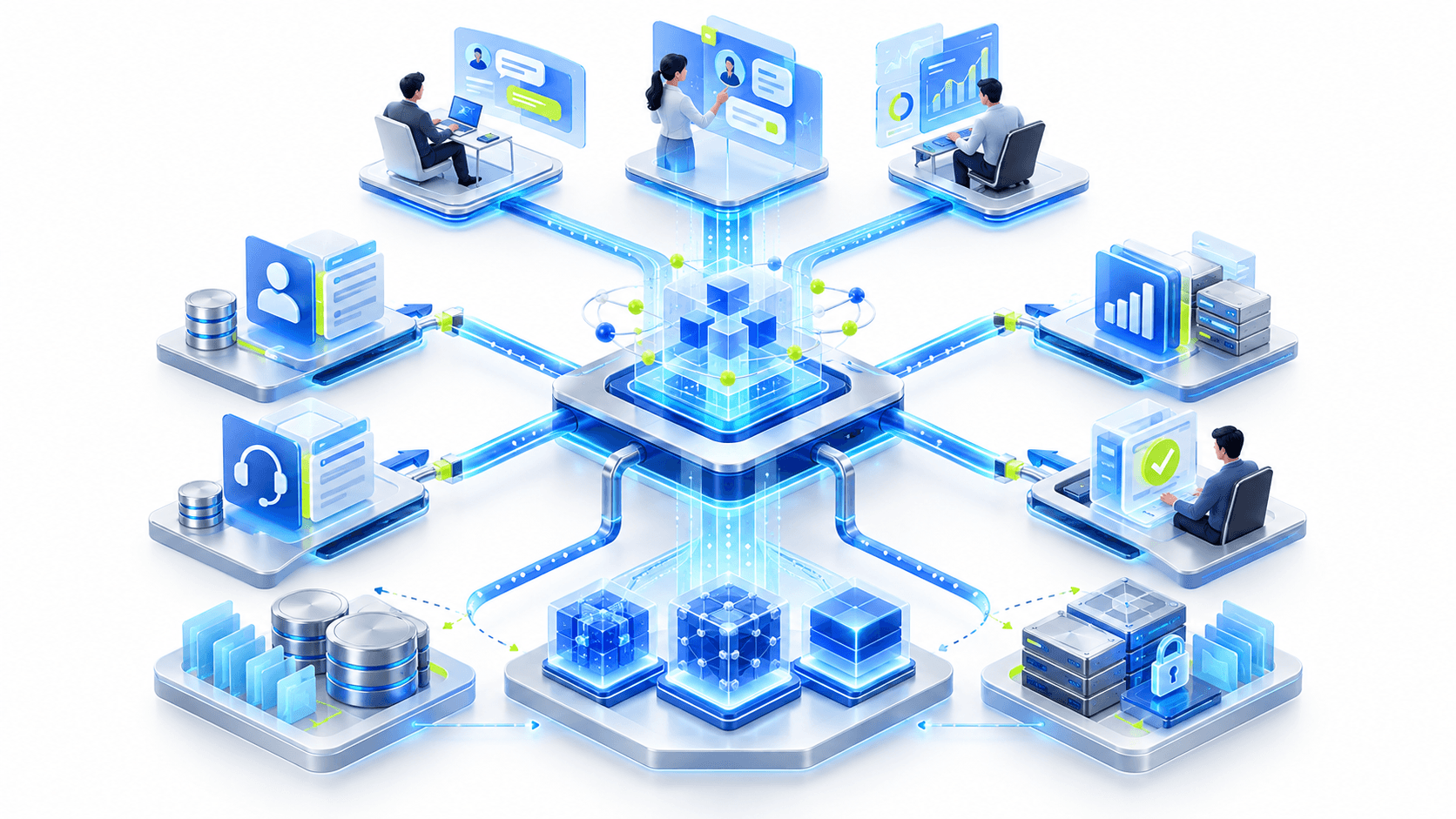
A production architecture separates responsibilities. The experience layer is where employees or customers work: an internal copilot, intelligent chatbot, contact-centre assistant, or embedded feature. The orchestration layer interprets the request, chooses a bounded workflow, calls approved tools, handles retries, and routes exceptions. The model layer may include language models, classification, forecasting, or computer vision, selected by task rather than novelty.
Make data and operations first-class architecture
The data and integration layer connects governed knowledge, operational records, APIs, and event streams. Use retrieval-augmented generation when the system needs to answer from controlled business sources; use deterministic services for calculations and actions that should not be guessed. Identity, policy, audit, and evaluation cross every layer. This is the foundation for AI Service Management (AISM): ownership, service levels, change control, cost visibility, incident response, and continuous quality management for AI services.
An AI orchestrator can be a workflow engine, agent framework, or a combination. Keep the workflow explicit where rules are stable; use agentic workflows where the system needs to select among tools or handle variable context. Multiple agents are not automatically better. A single well-scoped agent plus deterministic services is often easier to secure, test, and operate.
A six-step method for moving from use case to production
1. Choose a process and baseline it. Map the trigger, participants, systems, handoffs, exception rate, cycle time, quality measures, and customer or employee impact. Define a target that matters to the process owner, not a proxy such as prompts served.
2. Classify decisions and risk. Separate low-impact drafting or retrieval from actions that change money, access, employment, safety, or customer commitments. For EU deployments, assess the intended purpose and applicable obligations under the AI Act; the European Commission identifies employment use cases such as filtering applications and evaluating candidates as high-risk examples. This article is operational guidance, not legal advice.
3. Pick the smallest effective pattern. Consider rules and conventional automation first, then NLP or predictive models, a GenAI application, an intelligent chatbot, or an agent. Use AI as a Service (AIaaS) for speed when its data, residency, security, and integration terms fit. Build or host more directly when control, latency, customization, or portability requires it.
4. Design orchestration and permissions. Give each component only the data and tools it needs. Make write actions reversible where possible; require explicit human approval for high-impact or unusual actions. OWASP calls out excessive agency as a risk that can arise from excessive functionality, permissions, or autonomy.
5. Evaluate the end-to-end workflow. Build a representative test set from real cases, including ambiguous inputs, stale knowledge, edge cases, prompt injection, and integration failures. Measure task success, factuality or groundedness, escalation quality, latency, cost, and downstream defects. For AI-Augmented QA/QC, retain conventional tests and independent review: generated tests can miss the same assumptions as generated code.
6. Release in stages and operate it as a service. Start with shadow evaluation or a limited cohort, compare with the baseline, monitor traces and incidents, train users, and define a rollback path. Expand only when the process owner accepts the evidence and support team can diagnose failures.
Explore: enterprise AI development services
Where AI-augmented engineering fits
AI-Integrated IDEs and coding assistants can help with explanation, boilerplate, test scaffolding, migration, and code search. They do not remove the need for architecture decisions, code review, threat modelling, or maintainability. Research is mixed because tasks, tools, participants, and settings differ: Microsoft Research reported a 26% average increase in completed tasks across three field experiments involving 4,867 developers, while a METR study of 16 experienced developers on familiar mature repositories found tasks took longer with the early-2025 tools tested. Treat both as evidence to measure locally, not as a guaranteed ROI forecast.
The same principle applies to AI In Customer Service. An intelligent chatbot should be judged on resolution quality, safe handoff, repeat contact, customer effort, and service cost, not just response speed. Build a feedback loop so frontline staff can flag wrong answers and product owners can improve knowledge and routing.
One enterprise pattern, many AI services
Agentic AI Applications for the Enterprise are only one part of the portfolio. Artificial Intelligence Services may also include Natural Language Processing (NLP) and Generative AI for knowledge work, intelligent chatbots for customer service, AI Service Management (AISM), workflow automation, data engineering, AI-Integrated IDEs, and AI-Augmented Software Engineering and QA/QC. The same architecture discipline helps teams decide which capability belongs in which workflow, and whether it should be bought as AI as a Service (AIaaS), integrated from a platform, or developed for a differentiated need.
FIX Intelligence provides AI consulting services and solutions that connect strategy to delivery: discovery, architecture, prototyping, integration, evaluation, training, and ongoing operations. The aim is not to put AI everywhere. It is to improve well-chosen AI-driven processes with controls that fit their impact.
The orchestration choice: workflow, agent, or hybrid?
Use a workflow when the sequence and decision rules are known. Use an agent when the next tool or step depends on contextual reasoning within a constrained task. Use a hybrid when predictable control flow surrounds one or more bounded agent decisions. This distinction keeps “agentic workflows” useful rather than turning every business process into an open-ended planning loop.
For decision-makers, the best architecture is the one your teams can explain, evaluate, secure, and change. FIX Intelligence, part of FIX Solutions JSC, helps organizations assess use cases, design AI-enabled architecture, integrate GenAI applications, and move AI-driven automation into governed operations across engineering, quality, data, and customer service.
Explore: FIX technology stack