Where AI can support finance teams
AI for Finance can assist with document intake, transaction and case classification, customer-service support, research synthesis, operational forecasting, and anomaly triage. These tasks often involve large volumes of information and repetitive review, making them candidates for carefully scoped assistance.
The role of AI should be explicit. A model may extract fields, summarize evidence, or prioritize a case for review; that does not make its output an approved credit decision, payment, investment recommendation, or compliance determination. Define who has authority to decide and what evidence they need.
Select a workflow and establish a baseline
Map the current process, including data sources, handoffs, exception queues, review effort, and the system that records the outcome. Choose a measurable problem such as document processing time, reconciliation exceptions, or time to route a customer request. Compare against the existing workflow and include human correction costs.
Prioritize uses with clear owners, authorized data, reviewable results, and bounded consequences. An early pilot should test operational fit and failure handling as well as model performance. Avoid using a polished demonstration or aggregate accuracy score as a substitute for evidence on representative finance cases.
Explore: AI for Finance services
Design controls for financial data and actions
Financial workflows may contain confidential, personal, or commercially sensitive information. Apply identity-aware access to records, minimize data sent to external services, define retention and logging rules, and assess vendor terms and deployment boundaries. Preserve traceability for relevant sources, model versions, approvals, and actions.
Keep financial calculations and eligibility rules in deterministic systems. Separate recommendation from execution; enforce permissions at the service layer, require appropriate confirmation for consequential actions, and verify changes against the system of record. Escalate ambiguous or unusual cases to an authorized person.
Separate decision support from automated financial decisions
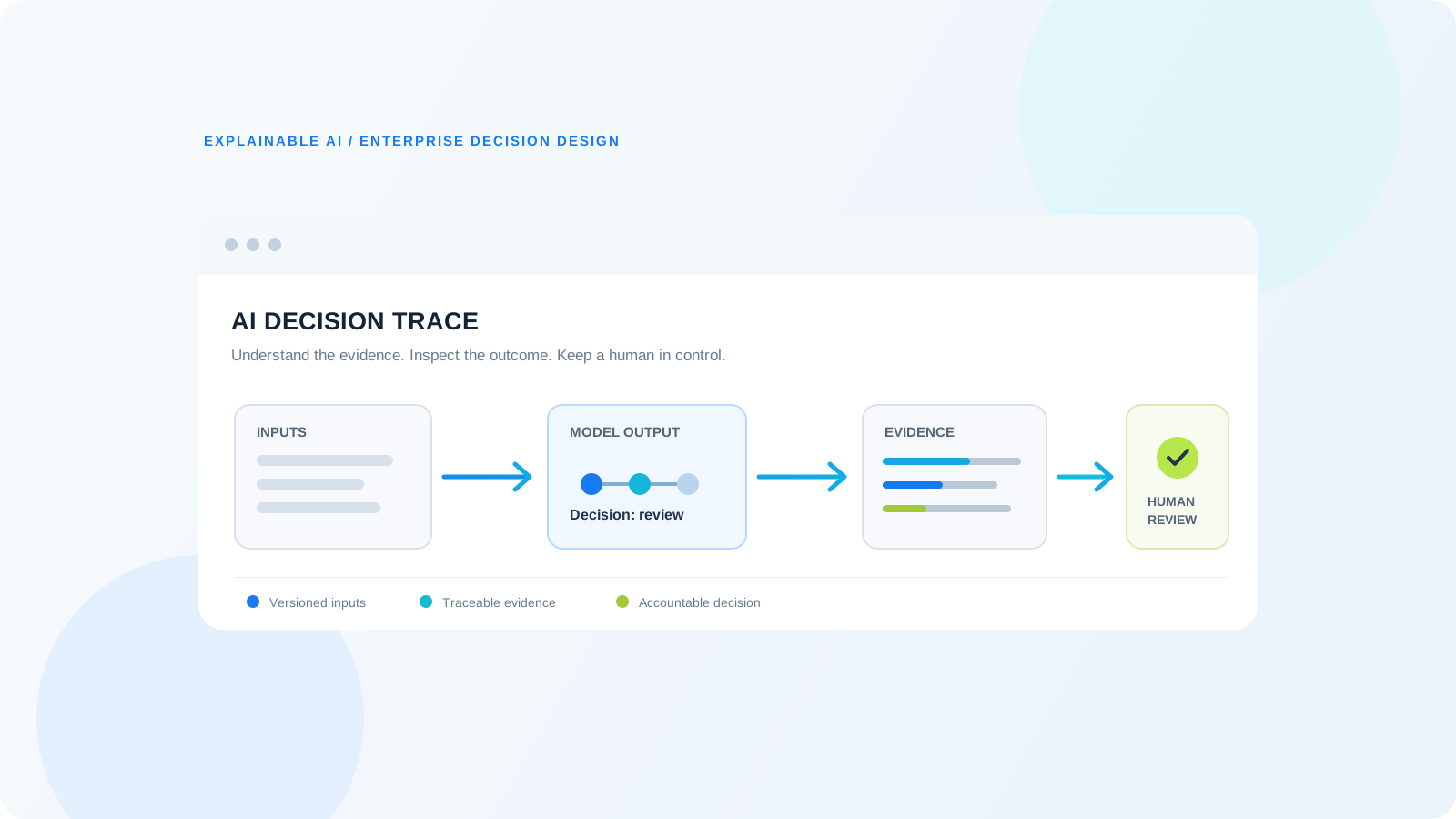
Consider an analyst reviewing an unusual payment. An assistant can assemble transaction history, retrieve the applicable procedure, and draft an investigation summary. The payment engine should retain responsibility for holds, releases, and approval limits. Keep retrieved evidence linked to the case so a reviewer can distinguish a recorded fact from a model inference. A fluent summary is insufficient evidence to authorize a transfer.
Start the evaluation with historical cases whose outcomes are known. Split evaluation data by time and customer where appropriate to reduce leakage. Measure missed suspicious cases, unnecessary escalations, analyst handling time, and the proportion of statements supported by evidence. Set separate acceptance criteria for each workflow; a customer-service assistant and a credit decision model require different controls.
Define ownership before connecting financial systems
Document which team owns the data, model validation, investigation queue, and final business decision. Give the assistant a scoped identity and initially limit integrations to reading approved records. Log the policy version, retrieved record identifiers, model configuration, and reviewer action without copying unnecessary personal information into logs. Retention and access rules should follow the institution’s applicable obligations.
Plan the failure path explicitly. If transaction data is delayed, a permission check fails, or evidence conflicts, route the case to the existing investigation process. Test those conditions before expanding access. Use the cited financial-sector guidance as context and confirm its jurisdictional scope with the institution’s risk and legal teams; US supervisory guidance is not a universal banking rule.
Use reconciliation exceptions as a bounded first implementation
For a reconciliation pilot, let conventional software match ledger entries and bank records by the institution’s approved rules. Send only unresolved exceptions to an assistant that groups likely causes and prepares an evidence packet. For example, a timing difference and a duplicated posting should remain distinct explanations. The assistant should identify the relevant entries, date window, and unresolved discrepancy rather than silently balance the records.
Ask the finance owner to review a sample containing timing differences, fees, reversals, duplicates, and genuinely unexplained items. Record whether the suggested category was useful and whether the cited records actually supported it. Compare reviewer effort and incorrect closures with the existing queue. Require an authorized reviewer to approve any journal adjustment through the accounting system. This separates information handling from changing the books and produces an auditable basis for deciding whether to expand the pilot.
Evaluate responsibly and scale with evidence
Build test cases that represent different products, customer segments, document quality, languages, edge cases, and known failure patterns. Measure the errors that matter to the workflow, review results with finance and risk specialists, and examine whether outcomes vary across relevant groups. Consult qualified compliance and legal teams about applicable obligations; this article is not legal advice.
Release in stages and monitor overrides, error rates, data quality, service reliability, latency, cost, and business outcomes. Establish owners for incidents, model or policy changes, and rollback. Scale only when the system improves the process without weakening required controls or obscuring accountability.
Explore: AI governance and runtime controls