What Explainable AI means in enterprise systems
Explainable AI (XAI) is a set of methods and operating practices that help people understand how an AI system produced an output, which inputs or patterns influenced it, and where its limits may lie. In an enterprise, that understanding must be useful to a specific audience: a customer asking why a decision was made, an analyst investigating an exception, an engineer debugging a model, or an executive assessing risk. One explanation format rarely serves all of them.
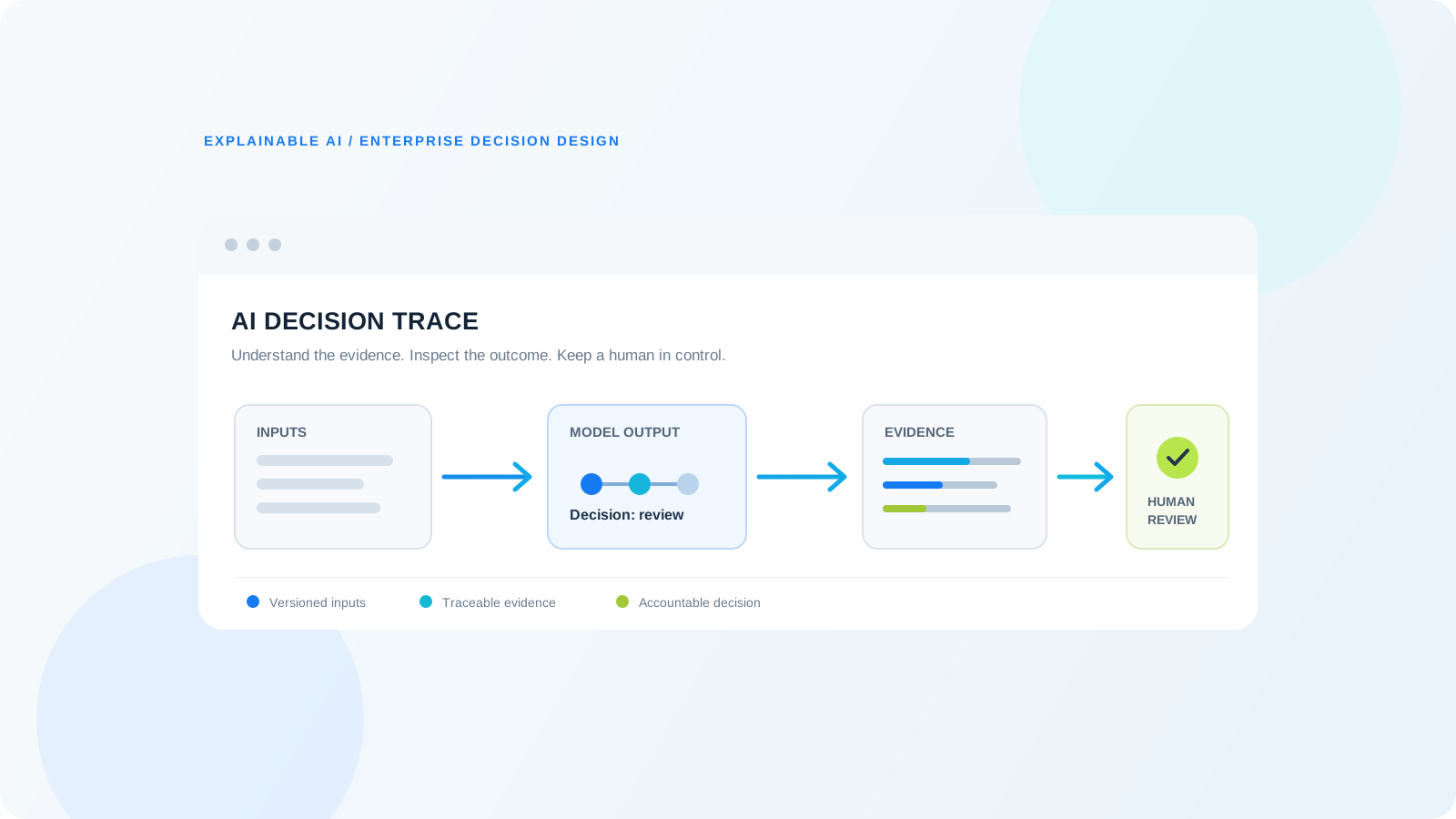
The need is broader than explaining a model after it has been deployed. Leaders need traceability across the decision path: the data and model version used, the context supplied, relevant rules or tools invoked, the output returned, and any human action taken. This is especially important when AI contributes to decisions about access, eligibility, money, employment, safety, or customer commitments. The exact legal duties depend on the use case and jurisdiction, so teams should involve appropriate legal and compliance specialists rather than treating a technical explanation as a compliance certificate.
Why explainability is a leadership and operating requirement
A model can perform well on an aggregate test set and still fail in a way that matters to a particular customer, region, product, or operating condition. When teams cannot reconstruct what happened, incident response slows down. Business owners may not know whether a poor outcome came from stale data, a changed model, a faulty integration, an ambiguous policy, or a human override. Explainability and decision records help turn a surprising result into an investigation that can be repeated and acted on.
Explainability also supports adoption. Employees are more likely to use recommendations when they can see relevant evidence, uncertainty, and the next safe action. Customers need a meaningful explanation and an appropriate route to question or correct information where the process calls for it. For CTOs and CIOs, the goal is not to make every algorithm fully transparent in an abstract sense. It is to provide enough reliable, audience-appropriate evidence to operate the system, challenge its output, and assign accountability.
Choose the right type of explanation
Begin with the system and decision, not a favorite XAI library. Some models are interpretable by design: a rules engine or a carefully constrained scoring model may expose its logic directly. More complex models may need post-hoc techniques that estimate which features influenced a particular prediction or how outputs change when inputs vary. These methods answer different questions and can have limitations. A feature-importance chart, for example, may describe model behavior but does not establish a causal reason for an outcome.
Generative AI requires additional care. A fluent rationale produced by the same language model may sound plausible without faithfully describing the internal process that generated the answer. Prefer verifiable evidence such as citations to retrieved source material, records of tool calls, policy checks, prompt and model versions, and the data scope used. Present these as provenance and supporting evidence, not as a claim that the model has exposed its private internal reasoning. Keep explanations concise, faithful to the system, and useful for the decision at hand.
A practical XAI implementation framework
1. Inventory decisions and owners. Map each AI-assisted workflow, the people affected, the system of record, the accountable business owner, and the consequence of an error. Separate recommendations from actions that change a record or determine an outcome. This risk map sets the level of explanation, review, and evidence required.
2. Define explanation needs by audience. A frontline reviewer may need the decisive evidence, missing information, confidence limitations, and clear approve, edit, or escalate options. An ML engineer may need feature behavior, drift signals, and reproducible model inputs. An executive may need a concise view of performance, exceptions, and control ownership. Specify what each audience must be able to understand or do.
3. Establish a reproducible decision record. Capture the minimum necessary context to reconstruct an outcome: model and configuration versions, relevant input references, retrieval sources or tool activity, output, applicable policy version, and human intervention. Apply access, retention, and data-minimization controls. A complete record is not a reason to retain sensitive information indefinitely.
4. Test explanations, not just predictions. Evaluate whether explanations are consistent, stable under small irrelevant changes, understandable to their intended users, and useful for detecting known failure modes. Use representative and edge cases, including missing or conflicting data. Ask domain reviewers to challenge explanations and verify that the evidence shown actually supports the stated conclusion.
5. Monitor and improve in production. Track model quality, explanation availability, overrides, complaints, escalation reasons, data and model changes, and time to investigate incidents. Set owners and thresholds for review. If an explanation becomes unreliable or unavailable, define whether the workflow should pause, fall back to a simpler method, or require human review.
Avoid common XAI failure modes
The first failure is equating explanation with correctness. A convincing feature attribution can accompany a biased or poorly specified model. The second is false precision: a numerical score may look authoritative while being uncalibrated for the population or decision in question. The third is explanation overload. Showing a long list of features or raw traces can make a review less effective, not more. Explanations should be tested with the people expected to use them and paired with clear limitations.
A further risk is treating one method as a universal solution. Different model classes, data types, decisions, and users need different evidence. Build an XAI approach into architecture and procurement: require access to useful logs, model and data versioning, evaluation artifacts, and a route to investigate vendor-managed components. Where the provider cannot expose internals, define compensating controls such as independent outcome testing, documented limitations, scoped use, and effective human escalation.
How FIX Intelligence can assist
FIX Intelligence, part of FIX Solutions JSC, can help organizations assess where explainability is needed and engineer it into AI products and workflows. Work may include AI use-case and risk mapping, data and model lineage, evaluation design, explainability method selection, retrieval and tool traceability, reviewer experience, monitoring, and integration with existing governance processes.
A practical engagement begins with one decision or workflow and a clear set of users. The team can document what evidence each audience needs, establish a baseline, prototype an explanation and review path, and test it against realistic cases before production. This keeps the effort tied to operational decisions rather than a dashboard that nobody uses.
Conclusion: make AI decisions challengeable
Explainable AI is most valuable when it helps a person understand a relevant result, investigate a failure, or take an appropriate next step. It is not a guarantee of truth, fairness, or regulatory compliance. Those outcomes depend on the complete system: data quality, model evaluation, governance, workflow design, monitoring, and accountable ownership.
CTOs and CIOs should start with consequential decisions, define explanation requirements by audience, preserve proportionate evidence, and validate that explanations are faithful and actionable. Then scale the pattern where it improves oversight and operations. FIX Intelligence can help turn that plan into an AI system people can inspect, challenge, and responsibly operate.