Why multimodal AI needs a broader evaluation plan
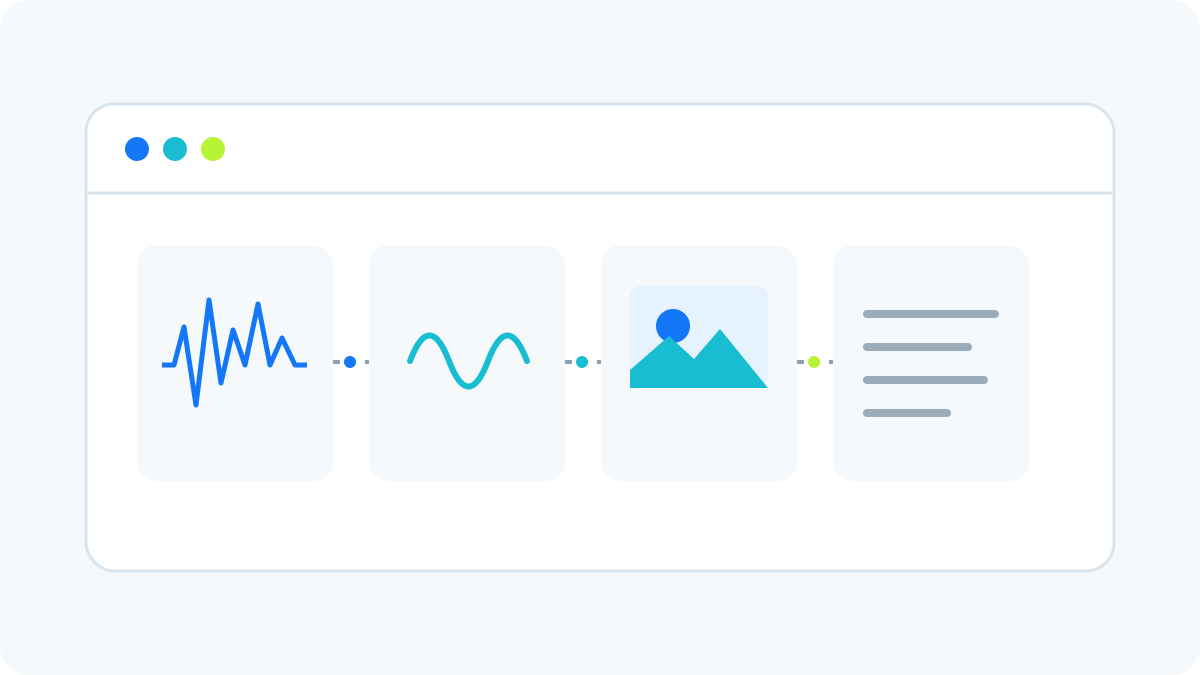
Multimodal AI systems combine inputs or outputs such as audio, text, images, and video. A speech assistant may recognize a request, retrieve information, call a service, and speak a response. A vision-language model may interpret frames and connect them to instructions. Testing only the final text can hide whether a failure came from transcription, visual understanding, orchestration, or speech generation.
For CIOs and product leaders, the evaluation plan should reflect the actual user journey. A voice agent can produce an accurate transcript but misunderstand intent, mishandle a correction, or speak a correct answer too late. A video model can describe a scene fluently while missing the relevant action or time boundary. Break the workflow into stages, define what good performance means at each stage, and also measure whether the complete task succeeds.
Build multilingual speech data with coverage and consent
Automatic speech recognition (ASR) and conversational speech systems need audio that reflects intended languages, accents, speaking styles, acoustic environments, and domain vocabulary. A corpus should include variation such as background noise, device quality, interruptions, code-switching, names, and industry terms where those conditions matter. Sampling only clean studio speech can overstate performance for customers using mobile devices or speaking in less represented ways.
Define annotation guidance before production begins. Specify transcription conventions, punctuation, speaker turns, timestamps, disfluencies, uncertain audio, and how annotators handle overlapping speech. Collect and use recordings with appropriate consent and permitted purposes. Minimize personal information, control access, document retention, and provide a process for correction or removal where applicable. Quality review should measure annotator agreement and error patterns, not only the number of hours processed.
Evaluate speech generation and voice interactions
Text-to-speech (TTS) evaluation covers intelligibility, pronunciation, pacing, prosody, consistency, and suitability for the context. Automated measures can help detect technical issues, but listeners are needed to assess whether speech sounds clear and appropriate across languages and accents. Include names, numbers, abbreviations, mixed-language phrases, and emotionally sensitive messages in the evaluation set. Test generated speech on the devices and networks customers actually use.
Voice-agent evaluation must include turn-taking and recovery. Test interruptions, silence, barge-in, corrections, ambiguous answers, transfers, authentication, and network delays. Track end-to-end latency, successful resolution, repeat requests, escalation, and user effort. A system should be able to slow down, clarify, or route to a person when recognition confidence is low or a request requires judgment. Do not optimize containment rate at the expense of a safe and understandable route to human assistance.
Label video and train vision-language capabilities responsibly
Vision-language model (VLM) data may connect frames, natural-language descriptions, objects, and actions. Video-action annotation needs consistent definitions for the start and end of an event, relevant objects, interaction state, and uncertainty. Annotators should distinguish what is visibly supported from what is inferred. Clear guidelines reduce disagreement and make it possible to diagnose whether a model missed an object, temporal sequence, or relationship between events.
Data selection must reflect the deployment environment and the people or spaces represented. Review consent, licensing, privacy, sensitive imagery, retention, and permitted use before assembling datasets. Use sampling and audits to find coverage gaps and labeling drift. Keep a traceable relationship between source media, annotations, transformations, and evaluation splits so that a result can be reproduced without leaking evaluation examples into training.
Measure the full system and improve it safely
Establish component-level baselines for ASR, TTS, visual interpretation, and tool execution, then add task-level measures such as resolution, time to completion, correction, abandonment, and escalation. Segment results by language, accent, environment, device, and task type where data volume supports meaningful comparisons. Review outliers with qualified annotators and domain experts. A single aggregate score can conceal a group for whom the system performs materially worse.
FIX Intelligence, part of FIX Solutions JSC, supports data preparation, AI development, evaluation, and integration. An engagement can begin with a data and workflow assessment, followed by annotation standards, a representative test set, and a measured pilot. Keep a human feedback loop and a release process for changes to models, prompts, and corpora. The outcome should be a multimodal capability that is useful in context, transparent about its limits, and supportable after launch.
Choose a delivery partner and pilot with evidence
When selecting a provider or engineering partner, ask how it handles recording consent, corpus provenance, annotator training, quality sampling, language coverage, and secure data transfer. Request examples of annotation guidance and evaluation reports with sensitive information removed. Clarify which assets your organization will own, how corrections are fed into later versions, and how the work will be maintained when the model or product changes.
A focused pilot should test a representative workflow rather than a polished demonstration. Agree on a small set of languages, intents, user conditions, and escalation cases. Define success and failure thresholds before seeing results, and include frontline reviewers in the assessment. The pilot should surface both model limitations and process changes required for adoption. If the test shows uneven performance, narrow the initial scope or improve the data before expanding access.
Plan for accessibility and ongoing data governance
Speech interfaces can reduce friction for some users and introduce barriers for others. Test with people who use different accents, assistive technologies, speaking patterns, and communication preferences. Offer a text or human alternative where voice is unsuitable. Review whether synthetic or generated voices could be confused with a real person, and make the system’s identity and capabilities clear to users.
Treat corpora and annotation rules as maintained product assets. Track provenance, version changes, quality defects, and requests to correct or remove data. Assign an owner for reviewing new languages and vocabulary as the service expands. This governance makes future evaluation faster and supports teams in explaining what data shaped a capability, who approved its use, and how a material quality concern will be handled.