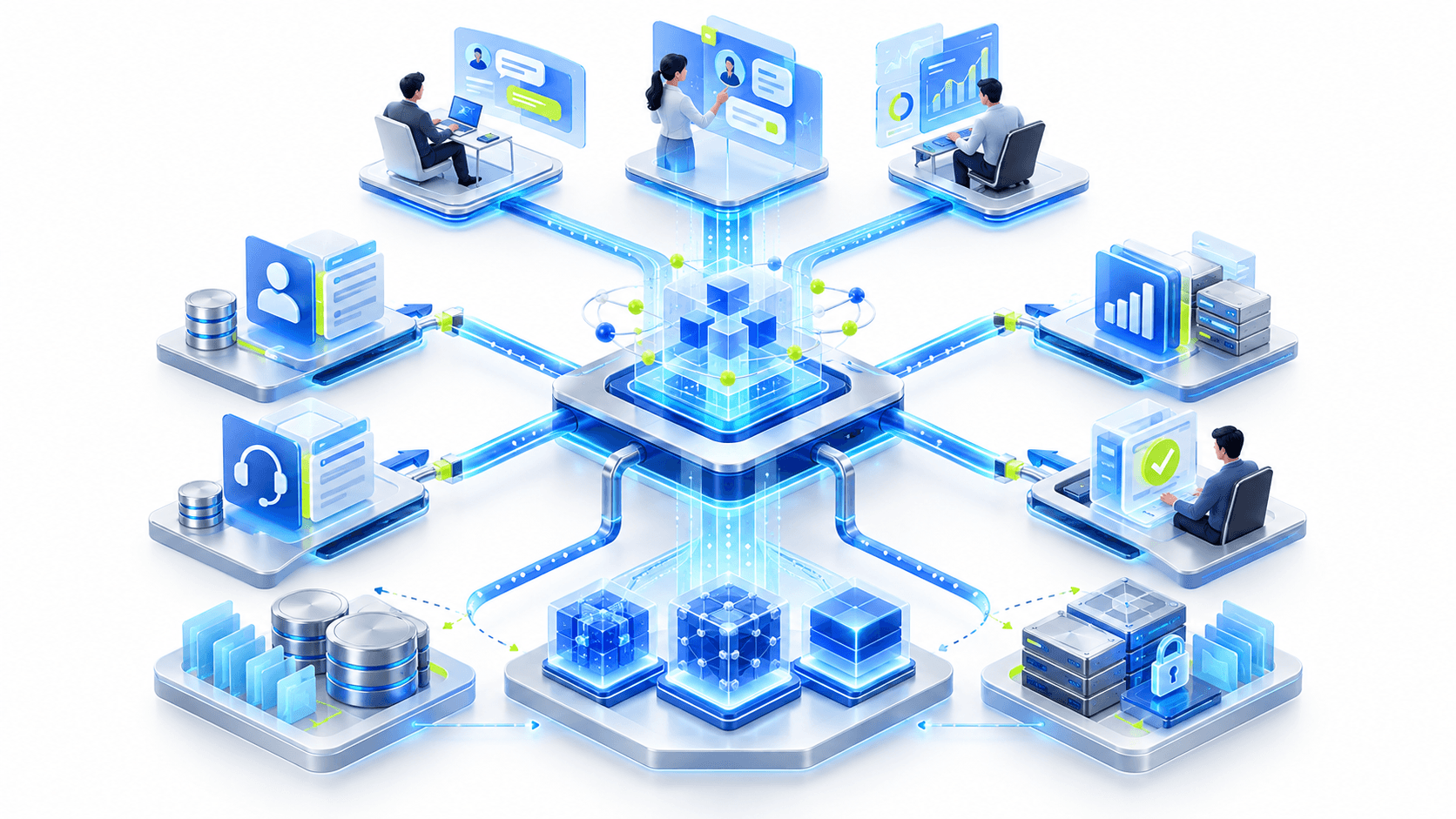
What Model Context Protocol (MCP) solves, and what it does not
The Model Context Protocol (MCP) is an open protocol for connecting AI applications to external context and capabilities. Instead of writing a different bespoke connector for every model client and data source, teams can expose reusable servers that provide resources, prompts, or callable tools. The client and server negotiate supported capabilities, giving developers a common integration shape for LLM data integration across development environments and business applications.
MCP is an integration contract, not a security product and not a guarantee that a model will use a tool correctly. A server still needs authentication, authorization, input validation, safe output handling, auditability, and operational ownership. “Connect LLMs to local data” should mean a deliberate, permissioned path to selected sources, not a blanket invitation for a model to inspect a developer workstation or corporate network.
Understand the connection before building it
An MCP host is the AI application a person uses. It manages one or more MCP clients, which maintain connections to servers. An MCP server presents a defined capability surface, such as searching approved policy documents, reading a project record, or creating a draft ticket. The application decides how to expose those capabilities to the model and user; the model does not directly acquire ambient access to every server simply because it speaks MCP.
Choose a transport and deployment model that fits the environment. A local server can run alongside a desktop client and access carefully scoped local resources. A remote server can serve authorized clients over a network transport and may better fit shared enterprise services. Network reachability, user identity, credential custody, and tenant boundaries differ between these designs, so document the trust boundary before implementation.
A six-step MCP implementation guide
1. Pick a narrow user task and name its owner. Identify the exact source, users, expected result, sensitivity, and failure path. Prefer one read-only lookup or retrieval use case over a broad “connect the company knowledge” project. Record how the existing process works so the team can compare accuracy, time, and operational effort after launch.
2. Define the capability contract. Give tools action-oriented names and descriptions, typed inputs, bounded outputs, and predictable errors. Separate search from mutation; separate creating a draft from submitting it. Expose only the minimum resource templates or prompts the workflow needs, and avoid dumping large or sensitive payloads into model context.
Explore: AI and data integration services
Identity, authorization, and the secure context protocol
3. Design authorization before connecting production data. Decide whether access is user-delegated or service-scoped, how the caller is authenticated, which audiences and scopes are allowed, how credentials are stored and rotated, and how access is revoked. Enforce authorization at the data source or server for every request. Do not rely on the model prompt to respect a user’s permissions, and do not share a powerful service token across unrelated users or tools.
4. Treat every server and tool description as an input that can be wrong or malicious. Use an approved server registry or allowlist, pin and review versions, verify provenance, and inspect changes to schemas and descriptions. Validate arguments, constrain destinations, defend against injection in retrieved content, rate-limit expensive calls, and return only necessary data. Require explicit human confirmation for consequential writes. These are application and deployment controls around MCP; calling it a secure context protocol does not make them optional.
Test, observe, and operate the integration
5. Build tests for both correct use and misuse. Cover missing and malformed inputs, authorization denial, stale or oversized content, prompt injection in source records, server timeouts, duplicate writes, tool errors, and revoked credentials. Evaluate whether the right tool was selected, whether the server enforced permissions, whether the answer cited the right source, and whether the workflow stopped when confidence or authority was insufficient.
6. Add production operations before broad rollout. Log actor, server, tool, request identifier, authorization outcome, latency, and error category while minimizing sensitive content in logs. Define retention, alerting, incident response, version rollback, and an owner for each server. Begin with a limited cohort; review real traces with security and process owners, then expand only when the observed outcomes meet agreed service and risk thresholds.
How to prepare for MCP in 2027
The 2027 outlook is greater attention to enterprise identity, authorization, lifecycle management, and predictable operation as MCP deployments connect to higher-value systems. The protocol community’s 2026 work has continued to evolve the specification and enterprise authorization capabilities. That direction is a signal to assess compatibility and governance early, not a promise that a particular feature or adoption curve will arrive on your schedule. Pin a known specification and SDK version, track support in the clients you actually use, and budget for upgrades.
Create an integration portfolio rather than a collection of hidden point-to-point servers. Catalog the owner, purpose, source systems, data classes, permissions, consumers, version, and service status of each server. Establish a review for new capabilities and a retirement path for old ones. This makes LLM data integration easier to explain to architecture and security teams and reduces duplicated connectors.
Architecture teams should also plan for mixed maturity. One client may support the features your application needs while another supports only a subset; one server may be maintained by a platform group while another belongs to a product team. Maintain a compatibility matrix, test the exact combinations in use, and document graceful fallback behavior. Avoid making a critical business process depend on an untested capability simply because it appears in a draft or roadmap.
Finally, treat context quality as part of protocol quality. A well-formed tool call can still return stale, incomplete, or misleading information. Include source timestamps and stable identifiers in results, limit output size, and preserve provenance through the application. Users and reviewers need to know not only that an integration worked, but which source informed the result and whether that source was current.
Choose MCP when it earns its place
MCP is useful when several compatible AI clients need a consistent way to access reusable tools or context. A direct API may remain the better option for a single application with stable, tightly coupled operations. Compare the ownership cost of operating an MCP server with the cost of maintaining a conventional integration; do not introduce a protocol layer merely to label an existing API as AI-ready.
FIX Intelligence, part of FIX Solutions JSC, helps teams assess AI architecture, design governed data access, integrate GenAI applications, and deliver production workflows. A sound MCP engagement begins with a bounded use case and a threat model, then proves the connection end to end before expanding the tool catalog.