Why AI augmentation is a team-design decision
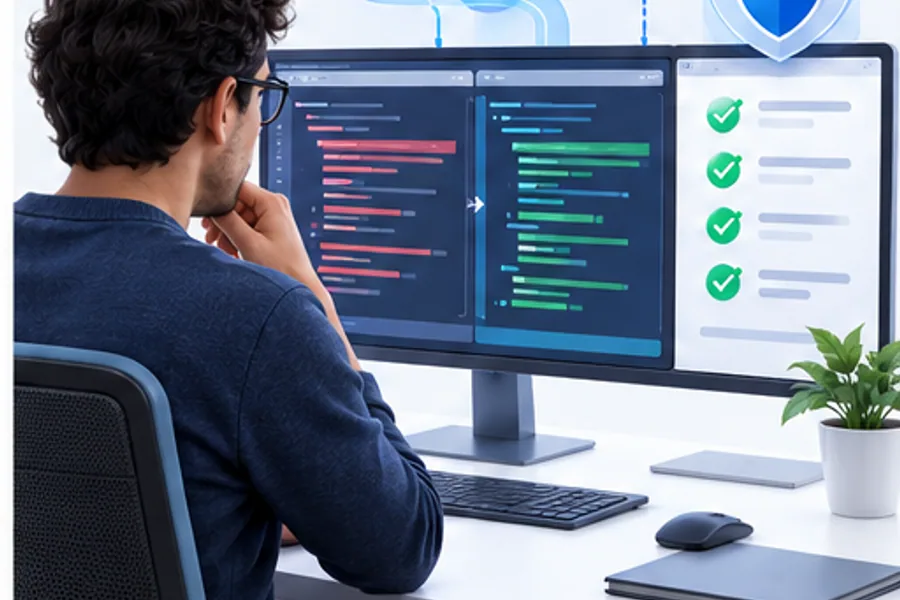
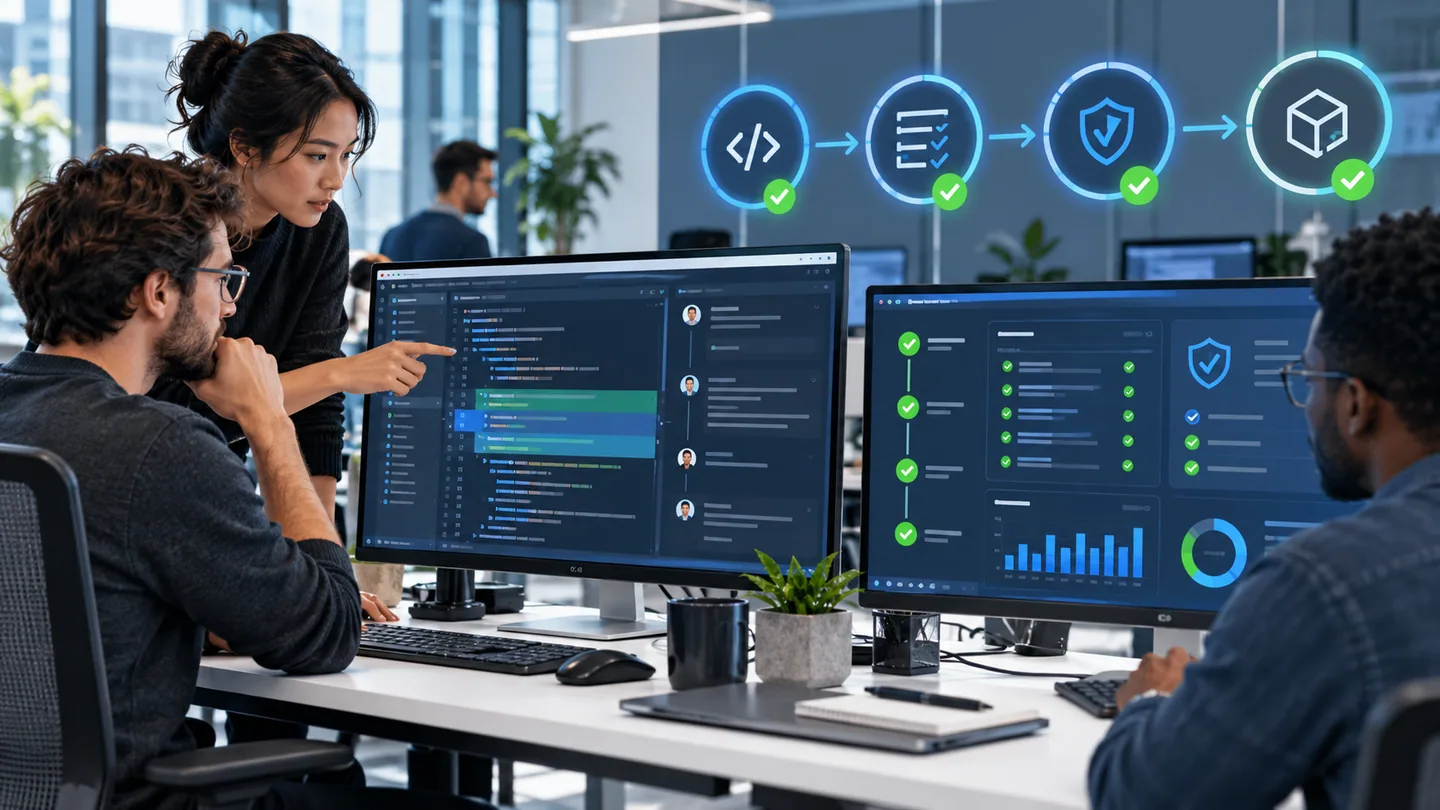
An AI-Augmented Development Team uses AI throughout the software lifecycle to help people understand requirements, explore code, implement changes, design tests, analyze failures, and maintain documentation. The defining shift is not that developers type faster. It is that the team deliberately changes how work is decomposed, reviewed, verified, and handed between product, engineering, QA/QC, security, and operations.
For CTOs and CIOs, this distinction matters. Adding tools to an unchanged process can increase local output while creating more code to review, more defects to diagnose, and more pressure on release controls. The target is better software outcomes: shorter time to a validated change, dependable quality, lower rework, a sustainable developer experience, and risk appropriate to the business. AI can contribute to those outcomes, but it does not own them.
The strongest operating model treats AI as a capable but fallible collaborator. People define the problem and acceptance criteria, supply authorized context, judge trade-offs, and accept responsibility for the result. AI can propose implementation options, generate tests, summarize evidence, or automate bounded steps. The engineering system must make it easy to validate those contributions and trace how a change reached production.
AI-Augmented Software Engineering across the lifecycle
In discovery and planning, AI can summarize product feedback, cluster support issues, explain legacy behavior, and turn an agreed requirement into candidate stories or acceptance tests. This is useful when the source material is large or fragmented. It is not a replacement for product judgment: teams must confirm user intent, business rules, privacy constraints, and non-functional requirements before implementation begins. A plausible specification can still encode the wrong problem.
During implementation, coding assistants can help navigate unfamiliar repositories, draft routine code, suggest refactors, explain errors, and generate documentation. Repository-aware tools may use project conventions, dependency metadata, and relevant files to provide better context. Keep that context permissioned. Exclude secrets and sensitive data, scope tools to the task, and run agents in environments where proposed changes can be inspected before they affect protected branches, production credentials, or live systems.
AI can also improve the preparation for review by summarizing a diff, identifying changed interfaces, proposing test cases, or flagging patterns for a human reviewer. Reviewers should still examine design choices, authorization, data handling, error behavior, dependency changes, and maintainability. Generated explanations are not evidence that the code is correct. The source change and its test results remain the objects of review.
After merge, AI can assist with release notes, migration documentation, incident summaries, and log investigation. These outputs should link back to authoritative commits, tickets, test runs, or operational records. If an AI-generated summary becomes part of a decision or audit trail, retain enough provenance to distinguish observed facts from inferred explanations.
AI-Augmented QA/QC: expand coverage without outsourcing judgment
AI-Augmented QA/QC applies AI to quality assurance and quality control activities such as test discovery, test-data preparation, test generation, failure analysis, defect clustering, and exploratory testing support. These capabilities can help teams identify cases that are easy to miss when test suites depend only on manually repeated scenarios. The purpose is to strengthen the quality system, not to declare software safe because an AI tool produced many tests.
Test generation can start from requirements, API contracts, code paths, user journeys, historical defects, or threat models. A generated test is valuable only if it checks a meaningful property. Teams need to inspect whether assertions are strong enough, whether the test is deterministic, and whether the test would fail when the behavior is actually wrong. A test that merely repeats the implementation’s assumption can create false confidence. Use mutation testing, seeded defects, code review, or other suitable checks to assess whether a suite detects meaningful failures.
Use AI to broaden functional and negative testing: malformed inputs, boundary values, unusual sequences, permission differences, localization, and recovery behavior. For systems that include AI, add evaluation for groundedness, consistency, refusal behavior, tool authorization, and sensitive-data handling. Keep conventional unit, integration, end-to-end, security, performance, accessibility, and compliance tests in the pipeline where they apply. Different techniques detect different classes of failure; one generated suite cannot replace layered verification.
In QA/QC triage, AI can group similar failures, summarize logs, compare a failing build with a known-good version, or suggest likely areas to investigate. The output should be treated as a hypothesis with supporting evidence. Preserve raw failures, environment details, and reproducible steps. A human owner should decide whether the issue is a product defect, flaky test, environment problem, or change in expected behavior.
Design a human-AI workflow the team can trust
Start by assigning each task to the most appropriate actor. Deterministic automation is a good fit for stable, repeatable rules. AI assistance can help when language, code context, or variable inputs make the task difficult to express as fixed rules. A developer or QA specialist remains responsible for decisions requiring architectural context, business consequences, or acceptance of residual risk. The workflow should make these handoffs explicit rather than hiding them inside a chat interface.
Define the task boundary before configuring a tool: what input it receives, which repository or environment it can access, what it may change, how success is evaluated, and when it must stop or escalate. For coding agents, use isolated branches or sandboxes, least-privilege credentials, resource limits, and reviewable patches. For test agents, prevent uncontrolled access to customer data and production environments. Log meaningful actions while avoiding unnecessary capture of sensitive prompts or source material.
Build feedback into the engineering loop. When a suggestion is rejected, capture the reason in a lightweight category such as incorrect behavior, poor fit to conventions, missing context, insecure pattern, or unnecessary complexity. When a test is flaky or unhelpful, record whether the issue lies in generated logic, test data, environment setup, or the assertion. These signals can guide prompt, retrieval, platform, training, and process improvements without turning every individual action into employee surveillance.
Make ownership clear. The developer who submits a change remains responsible for understanding it. QA/QC owns the quality strategy and evidence, not a blanket guarantee. Platform engineering owns the approved tool paths and shared guardrails. Security sets requirements and reviews high-risk integrations. Product and business owners define intended behavior and acceptable trade-offs. This division lets teams move quickly without diffusing accountability.
Choose a team topology that matches your starting point
There is no single organizational model for AI-augmented engineering. A small central enablement group can maintain approved tools, secure environments, reusable prompt and retrieval patterns, evaluation frameworks, and training. Product-aligned engineering teams can then apply those capabilities to their codebases and workflows. This model promotes consistency without making a central AI team the bottleneck for every experiment. In organizations with mature platform engineering, these responsibilities may fit within the developer platform function; in other environments, security or engineering excellence may co-own them.
Keep product and quality accountability close to the teams that own the service. QA/QC expertise should shape risk analysis, test strategy, and release evidence, while developers remain responsible for the changes they propose. Platform specialists should provide guardrails as paved paths rather than policy documents alone. As adoption grows, create a community of practice to share failure patterns, effective evaluations, and reusable controls. Review responsibilities as tools gain new capabilities, especially when an assistant moves from suggesting code to executing multi-step changes.
Measure engineering and quality outcomes together
Avoid using prompts, accepted completions, generated lines of code, or test count as the main measure of success. Those are activity indicators and can rise while delivery performance stays flat or quality declines. Establish a baseline for the workflow and compare similar work over a meaningful period. Segment results by task type, codebase maturity, developer experience, and risk so the organization does not mistake one team’s result for a universal effect.
A balanced scorecard can combine flow, quality, and team health. Track lead time from approved work to production, review queue time, change failure and rollback rates, escaped defects, rework, test flakiness, and security findings. Pair these with developer-reported usefulness, cognitive load, and trust. For AI-Augmented QA/QC, examine defect detection and escape patterns rather than coverage percentage alone. A metric should support an operating decision, not become a target that encourages gaming.
A staged adoption roadmap for CTOs and CIOs
Phase one is readiness. Select a workflow with clear ownership and manageable risk. Review repository permissions, data handling, development environments, testing maturity, branch protections, and security policies. Interview developers and QA specialists about where they lose time and what errors are expensive. Choose a baseline and agree on success and stop criteria before introducing new tooling.
Phase two is a bounded pilot. Start with assistive use cases such as code explanation, documentation drafts, test-case suggestions, or failure summarization. Keep changes human-reviewed and avoid production credentials. Train participants on verification, data restrictions, and reporting tool failures. Include both everyday tasks and harder edge cases; a pilot of only small, greenfield examples will not predict performance in a mature enterprise codebase.
Phase three is workflow integration. Once evidence supports the use case, integrate AI into approved IDEs, repositories, CI pipelines, test management, or internal developer platforms. Add policy checks, audit records, evaluation suites, monitoring, and a support route. Optimize the bottleneck the pilot exposed: it may be test reliability, build duration, architecture coupling, or review capacity rather than model quality.
Phase four is governed scale. Expand by team or repository only when quality and delivery signals remain acceptable. Review model and tool changes, manage vendor and data risks, update training, and periodically re-evaluate whether each capability still adds value. Preserve a route to disable or roll back features. Adoption is a continuing engineering capability, not a one-time license rollout.
Common failure modes and how to prevent them
The first failure mode is measuring individual speed while ignoring system throughput. If AI increases the number of changes entering review but the review team and test pipeline remain constrained, queues grow. Track work from idea to stable release and address the limiting stage before increasing change volume.
The second is treating generated tests as independent verification when they were derived from the same mistaken requirement or implementation. Use multiple sources of test intent, independent review for high-risk behavior, and defect-based checks that challenge the suite. The third is granting broad repository or system access to autonomous tools for convenience. Scope permissions, isolate execution, require approvals for sensitive actions, and retain logs sufficient for investigation.
The fourth is replacing team learning with opaque automation. If only a tool understands a code change, maintenance risk has increased. Require contributors to explain material changes, preserve clear diffs and documentation, and use AI to support knowledge transfer rather than bypass it. Finally, beware of automation bias: a polished answer or green dashboard can feel authoritative. Build procedures that make it easy to question results and recover when they are wrong.
How FIX Intelligence can support an AI-Augmented Development Team
FIX Intelligence, part of FIX Solutions JSC, can help enterprises design and strengthen AI-Augmented Development Teams across software engineering and QA/QC. Engagement may include workflow assessment, AI tool and platform selection, secure integration, developer enablement, repository-aware coding workflows, test strategy, automated QA, evaluation, and production governance. The scope should follow the delivery bottleneck and the client’s security, data, and quality requirements.
For AI-Augmented Software Engineering, FIX can assist with architecture and implementation practices that help teams use AI while maintaining reviewability, security, and ownership. For AI-Augmented QA/QC, FIX can help map risk-based coverage, introduce test-generation and failure-analysis support, and measure whether the approach finds meaningful defects without adding unacceptable noise or maintenance burden.
A strong engagement leaves the organization with more than tool access: a measured baseline, a practical operating model, approved workflows, team training, evaluation criteria, and a scale-up plan. This makes it possible to expand where evidence supports the investment and revise or stop where it does not.
Conclusion: augment the team, strengthen the system
An AI-Augmented Development Team is built by aligning people, platforms, and controls around better software outcomes. AI-Augmented Software Engineering can reduce friction across implementation and maintenance; AI-Augmented QA/QC can help teams explore risk and improve feedback. Neither removes the need for engineering judgment, independent verification, secure practices, or clear accountability.
For enterprise leaders, the practical sequence is straightforward: baseline a real workflow, pilot a bounded capability, verify its effect on both flow and quality, then scale with governance and human ownership intact. FIX Intelligence can help your organization turn that sequence into a delivery capability tailored to its products, teams, and risk profile.